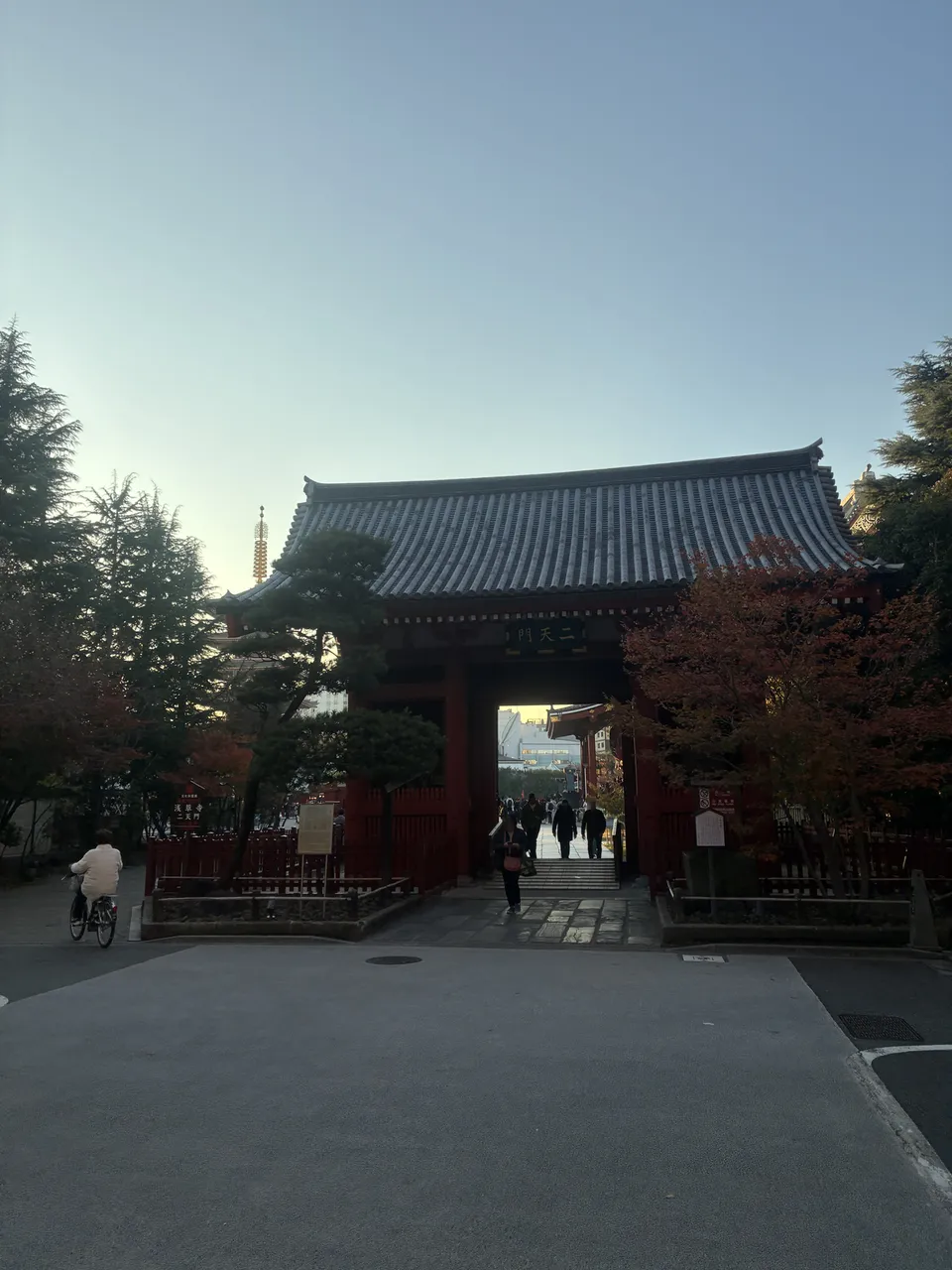
Nitenmon Gate: Senso-ji's Quiet East Gate from 1649
Nitenmon is Senso-ji's east gate, built around 1649 and a rare early-Edo survivor in the grounds. It is a free, five-minute stop on the quiet side of the main hall, with two 17th-century guardian statues. Come in daylight; the gate is not part of the nightly light-up.
Quick facts
- Entry
- Free
- From Asakusa Stn
- About 7 min (est.) from Ginza Line Exit 1, via Nakamise
- Step-free
- Ginza Line Exit 1 has a street elevator; one step-free route down to Platform 1 (Tokyo Metro)
- Time needed
- 5 min
- Light-up
- Not lit (the temple lights the main hall, pagoda, Hozomon and Kaminarimon)
- Address
- East side of Senso-ji, 2-3 Asakusa, next to Asakusa Shrine
What is Nitenmon?
Nitenmon (二天門, “Gate of the Two Heavenly Kings”) is the red gate on the east side of Senso-ji. Walk through it and you are a few steps from the main hall, with Asakusa Shrine just to the north. Most visitors arrive through Kaminarimon and Hozomon and never see it.
That is a pity, because it is the old one. Hozomon, the inner gate on the main approach, burned in the 1945 air raids and was rebuilt in reinforced concrete in 1964. Nitenmon is a wooden gate from the early Edo period, which Senso-ji calls a valuable survivor in its grounds, and a National Important Cultural Property. The Taito City sign at the gate gives the designation year as 1950.
How old is it?
Senso-ji dates the present gate to 1649, built as the temple’s east gate. The temple also notes a second account: that it was first built in 1618 as the guardian gate (zuishinmon) of a Tosho-gu shrine, a shrine to the first Tokugawa shogun, that stood in the grounds. Sources differ on the date, Senso-ji says.
The Taito City sign joins the two stories. It says the gate was evidently built around 1649 as the east gate, but throughout the Edo period it was thought of as the Tosho-gu’s guardian gate. The shrine itself burned in 1631 and 1642 and was moved inside Edo Castle. The gate kept the name Zuishinmon for over two centuries.
Why is it called the “two heavenly kings” gate?
Because of a change in the Meiji era. When the government separated Shinto from Buddhism, the gate’s two Shinto guardian figures went to Asakusa Shrine, in 1884 according to Senso-ji. Two Buddhist kings from Tsurugaoka Hachimangu in Kamakura took their place, and the gate became Nitenmon. The name plaque, written by the statesman Sanjo Sanetomi, is dated February 1, 1883; Senso-ji’s own page gives both years.
Those statues were lost in 1945: they were away for repairs and burned in the war (Senso-ji).
What is there to see?
- The two guardians. Facing the gate, Jikokuten (guardian of the east) stands on the right and Zochoten (guardian of the south) on the left. They are early-Edo wooden figures by the Kyoto sculptor Yoshida Hyobu Fujifusa, and a Tokyo-designated cultural property. They came here in 1957 from Kan’ei-ji in Ueno, from the mausoleum of the fourth shogun, Tokugawa Ietsuna (Senso-ji; Taito City sign). They stand behind netting, so look closely to see the color still left on their faces and armor.
- The gate itself. A vermilion wooden gate on eight pillars under a gabled, tiled roof. A major restoration in 2007–2009 returned it to its original look (Senso-ji).
- The stone water basin. Beside the gate, a temple sign explains an old basin given in 1777, probably by Senso-ji’s fire brigade. It is carved “in front of the Zuishinmon” and still stands where it always did. It is no longer used for washing hands.
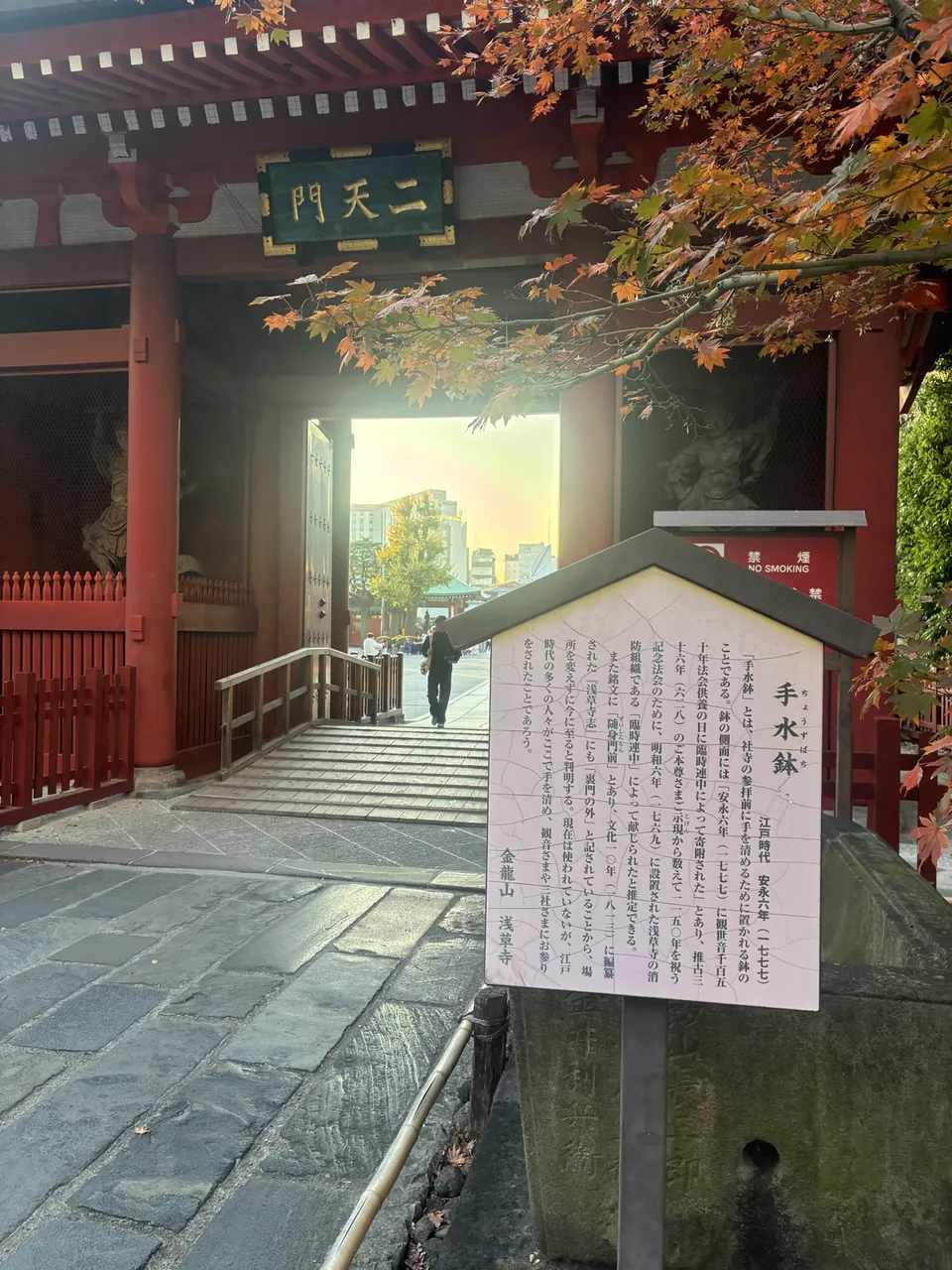 Nitenmon, Senso-ji, November 27, 2026.
When is the best time to go?
In daylight. Senso-ji lights the main hall, the pagoda, Hozomon and Kaminarimon every night until about 11 p.m., but Nitenmon is not on that list. In late November, the maples beside the gate turn red.
The gate is also the natural way out to the east. From here it is a short walk to the Sumida River, Sumida Park and Hanakawado Park with the Ubagaike site, about 250 m away (est.).
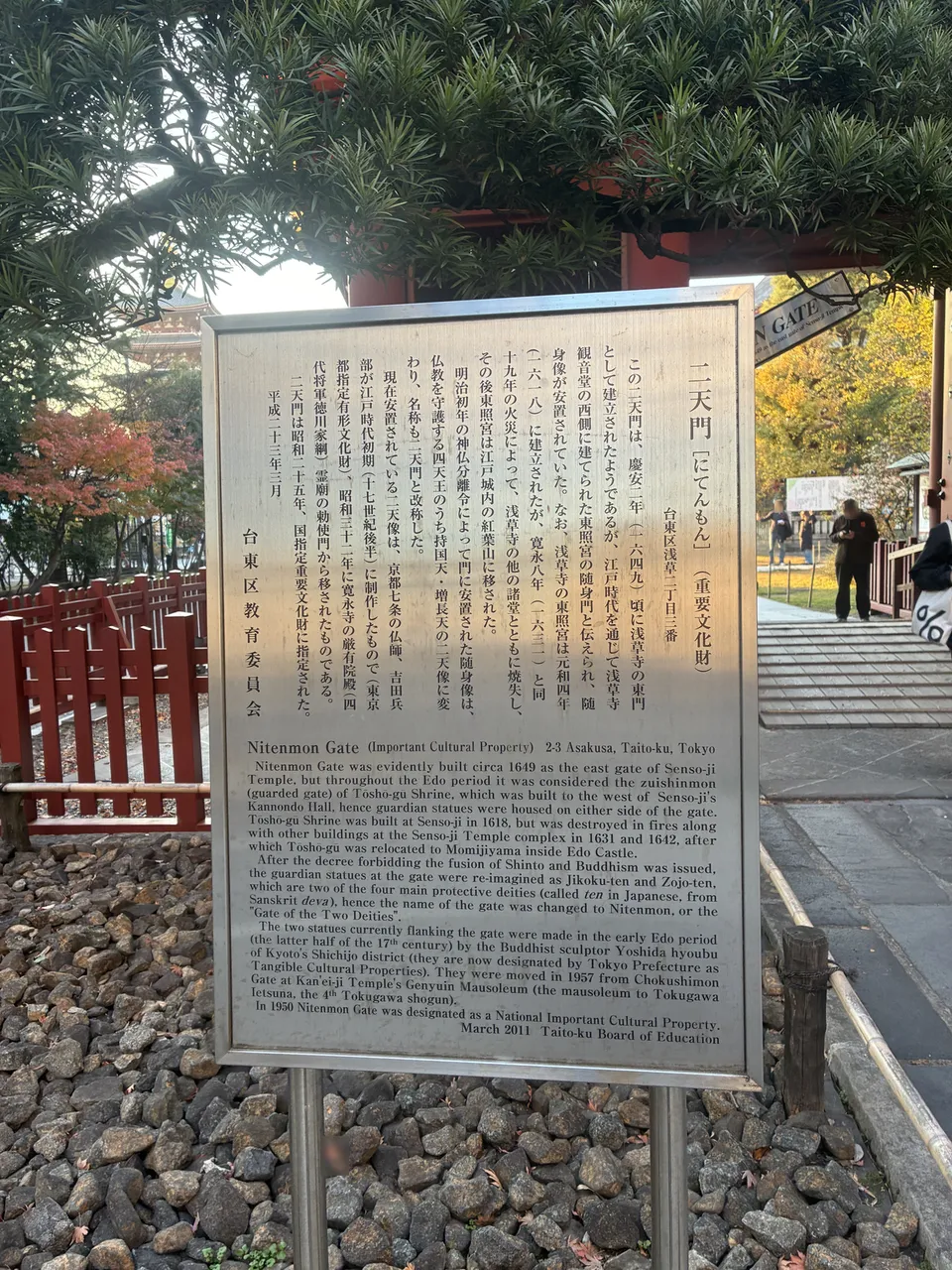 Nitenmon, Senso-ji, November 27, 2026.
Getting there
From Ginza Line Exit 1, walk up Nakamise to the main hall and turn right: about 7 minutes (est.). The passage through the gate has a few stone steps. Exit 1 has a street elevator, and Tokyo Metro lists one step-free route between the street and Platform 1. For the other lines, see Asakusa Station.
Nearby
Asakusa Shrine is next door to the north. East across the road is Hanakawado Park, a neighborhood park with a big playground and the Ubagaike pond legend; farther on is the river at Sumida Park. For a longer loop north, try the Oku-Asakusa walk. More: Asakusa travel guide.