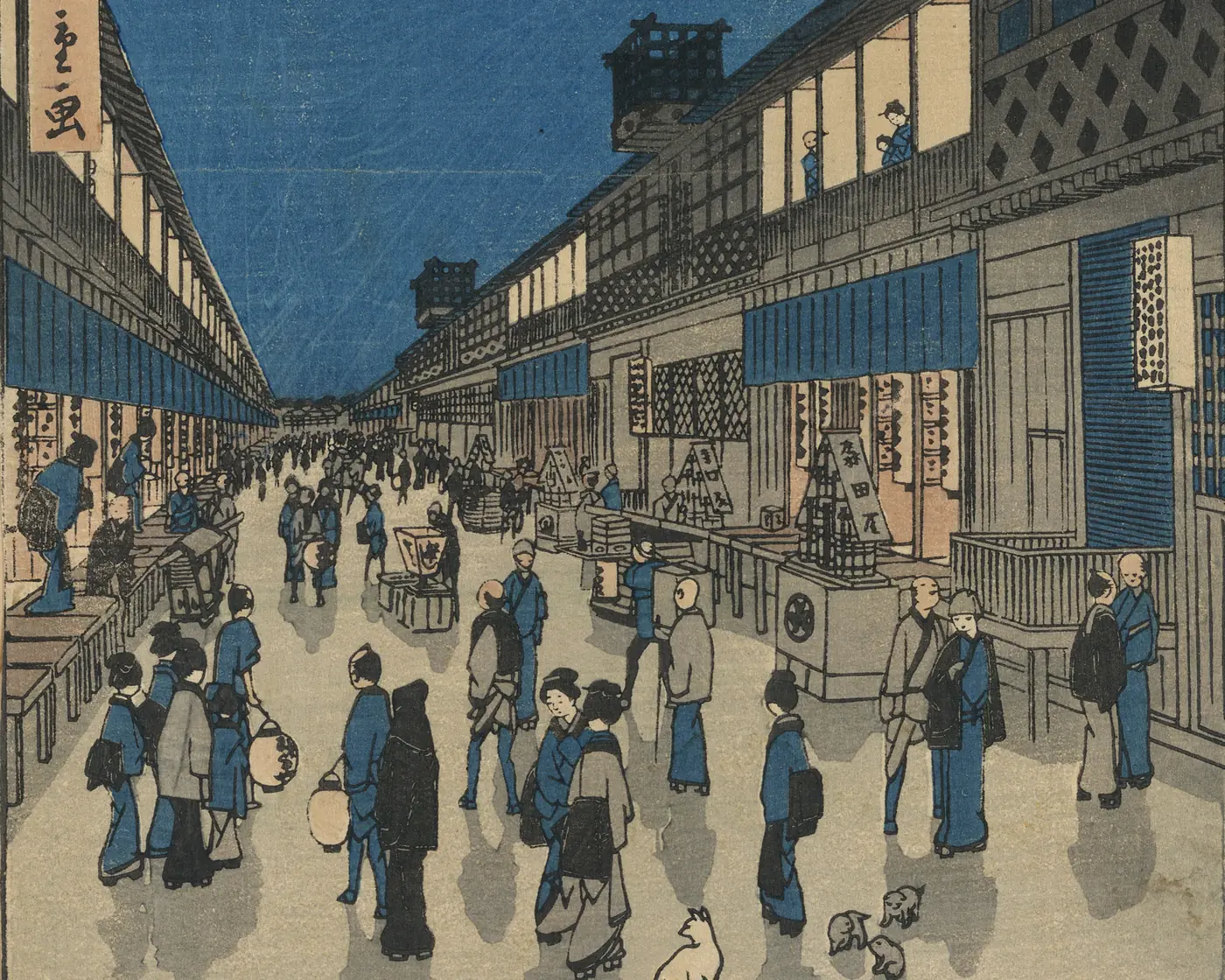
Saruwaka-machi: the lost kabuki theater town of Asakusa
For about 30 years Edo's three licensed kabuki theaters stood together in Asakusa 6-chome, a district called Saruwaka-machi. Today three markers on quiet streets, within about 100 m of each other, recall it. Free and always open; give it 5–10 minutes on the way between Matsuchiyama Shoden and Senso-ji.
Quick facts
- Open
- Street markers, always visible
- Entry
- Free
- From Asakusa Stn
- About 10 min walk (780 m, est.)
- Time needed
- 5–10 min
- Addresses
- Monument 6-19-4, Ichimura-za 6-18-13, Morita-za 6-26-11 Asakusa
What was Saruwaka-machi?
Edo’s theater town. In 1841, at the start of the Tenpo reforms, the shogunate ordered Edo’s three licensed kabuki theaters (the Edo sanza) out of the city center to the site of a former daimyo estate in Asakusa Shoden-cho. The new district was named Saruwaka-machi. The Nakamura-za moved to 1-chome and the Ichimura-za to 2-chome; the Kawarazaki-za, which the Japan Arts Council lists as the Morita-za, followed to 3-chome in 1842–43. Puppet theaters came too.
Actors and everyone else in the business were ordered to live in the district. For three decades it was the center of Edo theater, until the Morita-za moved to Shintomi-cho in 1872 (Japan Arts Council). The area is now part of Asakusa 6-chome.
What is left to see?
Very little: three markers on residential streets, all within about 100 m. The Oku-Asakusa Tourism Association’s walking map lists them:
- Saruwaka-cho monument (猿若町碑), 6-19-4 Asakusa
- Ichimura-za site (市村座跡), 6-18-13 Asakusa
- Morita-za site (守田座跡), 6-26-11 Asakusa
This is a stop for kabuki fans and history walkers, not a sight in itself. Read the history first, look at the markers, and picture three theaters on the street where the houses are now.
What happened to the theaters?
The Morita-za (written 森田座 until 1858, then 守田座) had been founded in Kobiki-cho in 1660 and arrived here in 1843. It moved to Shintomi-cho in 1872 and was renamed the Shintomi-za in 1875 (Japan Arts Council).
For the Ichimura-za, the landowner Umemura Shozaburo, who had invested in it, pushed a plan to move it to Shitaya Nichomachi (Taito City).
Is there anything from the theaters you can still see?
Yes, one object. A long zelkova drum made for the Ichimura-za by an Asakusa drum maker was finished on August 27, 1878, according to the ink inscription inside. It was probably used for performances. The town council later used it on festival floats. It is a Taito City cultural property, and since 2005 it has been kept at the Miyamoto Unosuke drum museum (2-1-1 Nishi-Asakusa) (Taito City).
Getting there
From Asakusa Station (Ginza Line Exit 1 area) it is about 780 m, 10 minutes on foot (est. from OpenStreetMap walking routes, not timed). Ginza Line Exit 1 has a street elevator (Tokyo Metro). Matsuchiyama Shoden, the hilltop temple by the Sumida, is about 5 minutes east (est.).
Nearby
Asakusa Fuji Sengen Shrine is a short walk west, and Senso-ji is about 10 minutes south (est.). The Oku-Asakusa walk ends here before heading back to the station. For everything else: Asakusa travel guide.
Header illustration: Utagawa Hiroshige, “Night View of Saruwaka-machi”, from One Hundred Famous Views of Edo, 1856. Art Institute of Chicago, public domain.