Senso-ji New Year 2027: hatsumode crowds and timing
Hatsumode, the year's first temple visit, is free at Senso-ji, but in recent years January 1–3 has brought a one-way route and entry control from Kaminarimon. Our estimate is that it's likely lighter from January 4. The main hall normally opens 6:30 a.m.–5 p.m.; New Year hours are announced in December.
“Honestly, I don't think you need to stand in line for tens of minutes. But as an experience, tossing a small coin into the big offering box gives you a little happy feeling. By the way, in Japan a 5-yen coin means "go-en", a connection. It's a small amount and it's lucky, so people used to throw 5-yen coins a lot.”
Senso-ji at New Year is a big event: hatsumode, the first temple or shrine visit of the year, brings huge crowds to the temple. Weathernews puts the usual turnout at about 2.9 million people, and Jorudan gives about 3 million for 2025. Both are estimates.
Quick facts
- Entry: free. You need coins for the offering box and the omikuji.
- Booking: none. There are no tickets for hatsumode or for the midnight bell.
- Main hall: normally 6:30 a.m.–5 p.m. from October to March. The temple’s pages give no separate New Year hours; it posts New Year details in December, and we’ll update this page then.
- Getting there: about 5 minutes on foot from Asakusa Station on the Ginza Line, Tobu Skytree Line, Tsukuba Express or Toei Asakusa Line (exit A4), according to the temple. The temple has no parking of its own.
- Step-free: Ginza Line Exit 1 has a street elevator, and Tokyo Metro’s Japanese barrier-free page lists one step-free route from there down to Platform 1, with an elevator inside the gates. Other lines: Asakusa Station.
- January 1–3, in recent years: a one-way route from Kaminarimon and entry control in the grounds. The 2027 arrangements haven’t been announced yet (as of November 12, 2026).
- Omikuji: paper fortunes from the hall beside the main hall. About 30% are kyo (bad luck).
- Rain: the grounds and the queue are open-air, so bring an umbrella if rain is forecast.
- Kids, strollers, cold: the midnight and January 1–3 queues mean a long, slow line outdoors in winter. That’s hard going with small children or a stroller, so dress warmly or come after January 3.
Do you need to queue at Senso-ji for New Year?
In my view, not really. I think I go for hatsumode roughly every two or three years, and honestly, I don’t think queuing for tens of minutes is necessary. The part I’d keep is small: tossing a coin into the big offering box. It gives you a little happy feeling.
My advice is to get that moment without the long line:
- Want the midnight moment? Join the queue at Kaminarimon late on December 31 and expect a long, slow walk.
- Want the experience without the wait? Go from Monday, January 4, 2027 (our estimate). The New Year services in the main hall run until January 7.
What happens at Senso-ji on New Year’s Eve?
These details come from the temple’s own event pages:
- Midnight bell: the New Year bell (joya-no-kane) is rung at Bentenyama, a small mound with a bell tower in the southeast of the grounds, not at the main hall. Three uncounted strokes come first, then 108, which take about 40 minutes.
- Who rings it: members of the temple’s Hyakuhachi-kai (108 Society). The temple’s page doesn’t say visitors can ring the bell. It describes the Hyakuhachi-kai ringing it while visitors gather.
- Main hall: when the bell rings at midnight, the New Year prayer service starts inside the hall. The temple says people pack the area in front of the hall and the approach, and cheer when the year turns.
- New Year services: Shushoe runs from the evening of December 31 to January 6. Shinnen daikitoe, the New Year prayer service, runs from January 1 to 7. It’s held every 30 minutes or every hour until close to closing time.
How does the queue and one-way route work?
In recent years, January 1–3 has worked like this, according to the Taito City tourism site:
- One-way Nakamise: from late on December 31, Nakamise became one-way toward the temple, according to the Asakusa Sightseeing Federation.
- Where the line started: at Kaminarimon. You couldn’t join from the side streets partway up.
- Entry control: the temple set a fixed route through the grounds and limited entry from January 1 to 3. It warned that getting into the hall to pray could mean a long wait.
- Roads: the Federation said traffic restrictions applied around the temple from the night of December 31 to January 3. Taxis may not be able to reach the gate.
- Live cameras: the temple links two official YouTube live streams from its homepage, one of the main hall and one of Kaminarimon. They run year-round, so you can check the crowd before you go.
- Local bus: Taito’s Megurin community bus detoured around the Asakusa Station traffic control on January 1–3 last season (2026). Check the city’s page for the 2027 timetable.
The 2027 route and entry control haven’t been announced yet (as of November 12, 2026). They will appear on the Taito City and temple pages in December, and we’ll update this page then.
When is Senso-ji least crowded at New Year?
No official source gives queue times, so this is our estimate, not a count. The busiest times are likely late December 31 into the early hours of January 1, then the daytime on January 1–3. In recent years, entry control ran from January 1 to 3 only. January 4 is a Monday in 2027 and the usual first working day.
What that means in practice:
- Skip midnight unless the countdown itself is the point. You’ll stand in a slow line from Kaminarimon, and you won’t see the bell: temple members ring it on Bentenyama.
- Go January 4–7. It’s still New Year at the temple, and the New Year prayer service runs until the 7th. Expect normal busy-day Asakusa crowds.
- If you go January 1–3, follow the marked route and allow plenty of time. For the rest of the year, the Senso-ji page covers the quieter times of day.
How do you pray at Senso-ji?
At the main hall, toss a coin into the offering box (saisen-bako), put your hands together quietly and make your wish. Common etiquette advice is not to clap at a Buddhist temple like Senso-ji. Clapping is the custom at Shinto shrines, such as Asakusa Shrine next to the main hall.
Which coin? Many people offer a 5-yen coin. Go-en (five yen) sounds like go-en (connection), so the coin stands for a good connection. The amount doesn’t matter. Pocket change is fine.
What about omikuji?
The omikuji hall is beside the main hall. You shake a numbered stick from a box and take the paper fortune from the matching drawer. Senso-ji’s fortunes are known for a high share of kyo (bad luck). It’s about 30%, following the traditional Kannon hyakusen set. The temple’s FAQ says that’s simply the traditional omikuji. If you draw a bad one, tie it at the marked place in the grounds and don’t worry about it.
Are trains running all night on New Year’s Eve?
Last season (New Year’s Eve 2025):
- No all-night service: Tokyo Metro (Ginza Line), Toei (Asakusa Line), Tobu and the Tsukuba Express. They all ran holiday timetables.
- All-night service: JR East, including the Yamanote Line through Ueno, and Keisei, on Keisei-Ueno to Narita and Oshiage to Keisei-Kanamachi.
The operators announce the 2026–27 plans in late November or December. We’ll update this page then. If last season’s pattern holds and you stay past midnight, plan your way home through Ueno or Oshiage, or by taxi.
Combine it with
If you arrive in late December, the year-end Hagoita-ichi battledore market fills the same temple grounds on December 17–19. For a day plan in the first week of January, follow the 2-hour Asakusa route. For everything else in the neighborhood, start with the Asakusa travel guide.
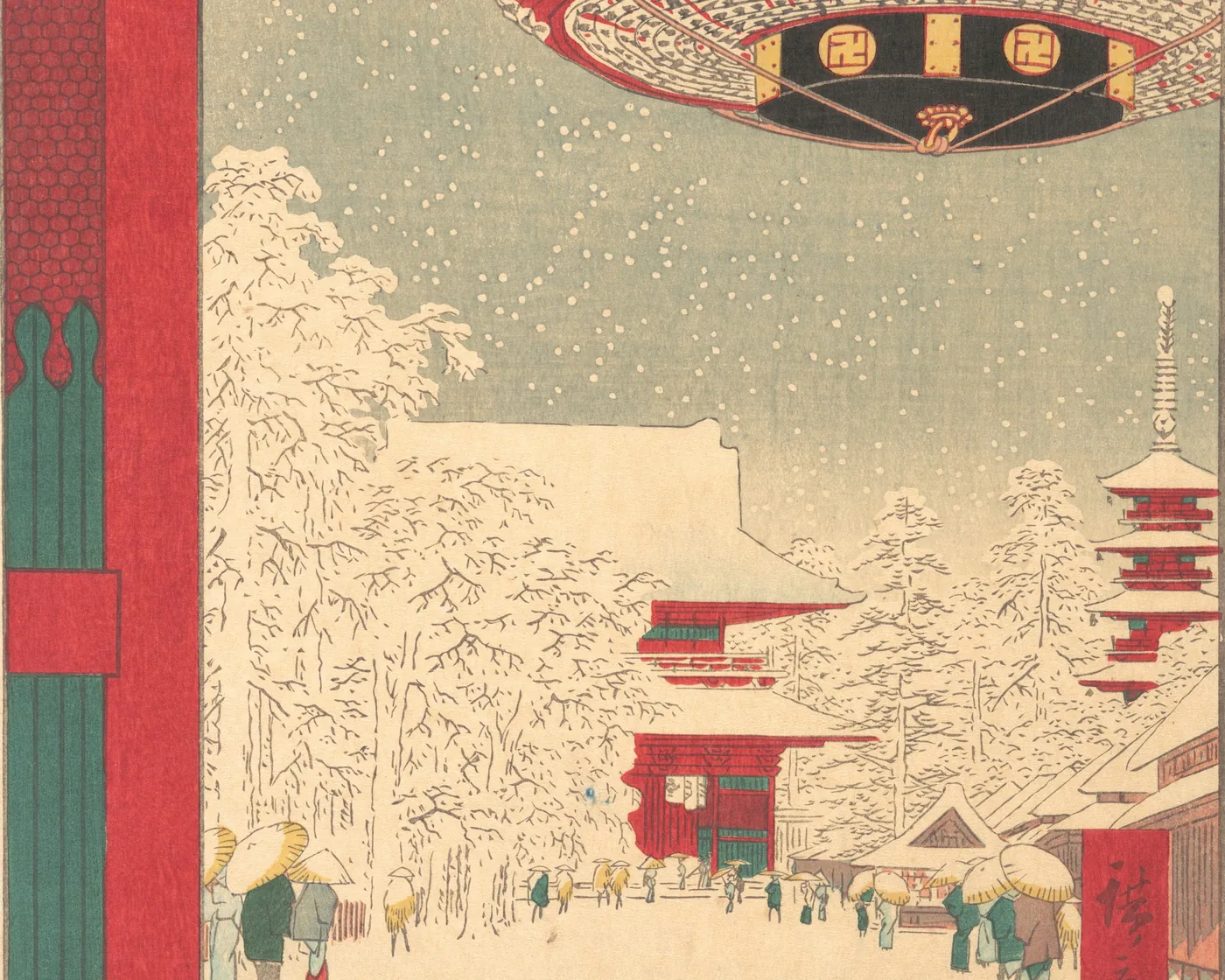
Header illustration (detail): Utagawa Hiroshige, “Kinryuzan Temple at Asakusa”, from One Hundred Famous Views of Edo, 1856. The view looks through Kaminarimon, under the great lantern, toward the inner gate and pagoda in snow. The Metropolitan Museum of Art, public domain.