Best Ramen in Asakusa: 6 Shops, Prices and Hours
Six independent ramen shops in Asakusa, ranked by Tabelog, not by our tasting. The top-rated, Men Mitsuwi, charged ¥1,200 for shoyu ramen in November 2026; you take a numbered ticket and wait. With no time to queue, Yoroiya, 3 minutes from Kaminarimon, is open every day and has a ¥1,400 vegan bowl.
Where the shops are
- Men MitsuwiOpen in Google Maps — Men Mitsuwi
- BilikenOpen in Google Maps — Biliken
- UruchiOpen in Google Maps — Uruchi
- YoroiyaOpen in Google Maps — Yoroiya
- RaishukenOpen in Google Maps — Raishuken
- Asakusa RairaikenOpen in Google Maps — Asakusa Rairaiken
Numbers match the ranking above. Map: OpenFreeMap © OpenStreetMap contributors.
Which ramen shops in Asakusa are worth it?
Ranked by Tabelog score, with Google Maps ratings alongside (see the chart). The order comes from those ratings, not from our own tasting.
| Shop | Known for | Price seen | Walk (est.) | Closed |
|---|---|---|---|---|
| Men Mitsuwi | Top 100 shoyu ramen, numbered tickets | Shoyu ¥1,200 (Nov 2026) | 1 min from Tawaramachi Station | Sun, Mon |
| Biliken | Hand-rubbed noodles, duck | ¥1,100 (Nov 2026) | 4 min from Kaminarimon | None (days off on social media) |
| Uruchi | Classic Tokyo shoyu, wontons | ¥950 (Nov 2026) | 1 min from Tawaramachi Station | None listed |
| Yoroiya | Yuzu shoyu, vegan bowl | Ramen ¥950 (official) | 3 min from Kaminarimon | Open every day |
| Raishuken | Old-style ramen since 1950 | Ramen ¥800 (Jun 2026) | 8 min from Kaminarimon | Tuesday |
| Asakusa Rairaiken | The 1910 name, back since July 2026 | ¥880 (Oct 2026) | 14 min from Kaminarimon | Open every day |
Prices are from the shop’s own site where it has one, otherwise what Tabelog reviewers paid, with the month.
If you only try one: Men Mitsuwi. It has the highest Tabelog score here and was on Tabelog’s Ramen TOKYO Hyakumeiten (Top 100) list in 2024 and 2025. Plan for the wait: you take a numbered ticket outside and come back when called, and November 2026 reviewers waited 30–45 minutes at lunch. It’s closed on Sunday and Monday. With no time to wait, go to Yoroiya.
How we chose and checked:
- Starting list: Tabelog’s Asakusa ramen ranking, read November 27, 2026.
- Who’s in: the highest-rated independent shops on that list down to Raishuken (3.58), plus Asakusa Rairaiken for its history (its score is lower). All are within about a 15-minute walk of Kaminarimon, and Google Maps listed all six as operating on November 27, 2026.
- Independent only: we list shops run by their owners, with up to two or three shops, and leave out company groups, brands with four or more shops and shops whose operator we couldn’t find. Biliken and Uruchi each have one sister shop (see their sections). That rules out Ramen Benkei and NO11 (four shops each), and Bazoku and Ikuta-an, whose operators we couldn’t find. For halal ramen, see halal and Muslim-friendly food in Asakusa.
- Order: by the score on each shop’s own Tabelog page, checked November 27, 2026. Google Maps shows no rating for Yoroiya, so the chart has only its Tabelog score.
- Walk times: our estimate from the map, not a timed walk.
- Taste: we haven’t eaten at these shops, so this page compares facts, not flavor.
Why is Asakusa a ramen town?
Because Tokyo-style shoyu ramen is said to start here. Rairaiken opened in Asakusa in 1910 and served rāumen in a clear broth seasoned with soy sauce, which is said to be the model for the shoyu ramen most Tokyo shops still make. The Asakusa shop closed during the war (Yoroiya’s site) and the business closed for good in 1976 (Toyo Keizai). In July 2026 a great-great-grandson of its founder reopened it in Asakusa (Toyo Keizai, July 2026).
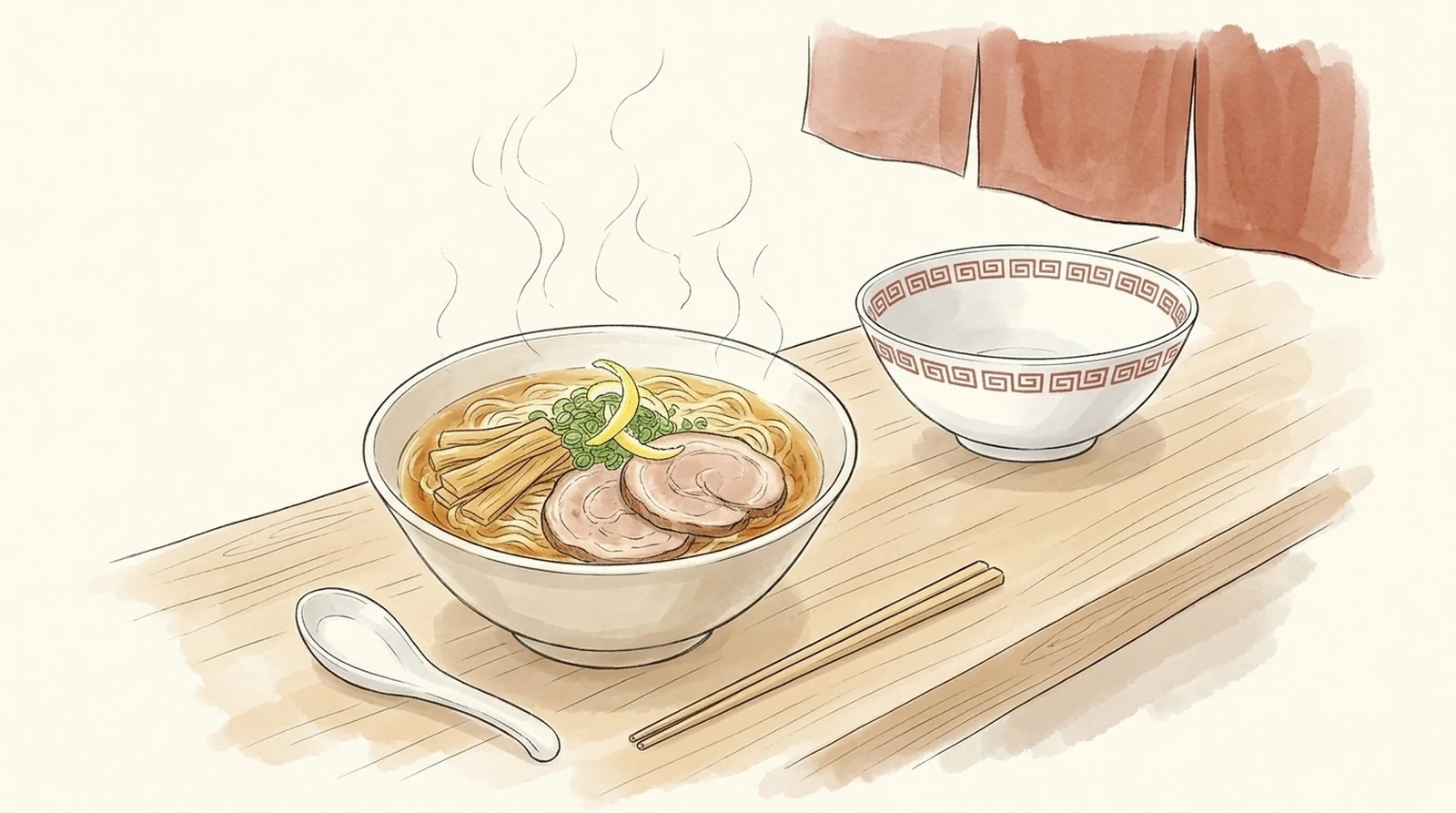
Most of the shops below serve that style, called shoyu (soy sauce) ramen or chūka soba (Chinese noodles): a clear brown broth, thin to medium wavy noodles, sliced pork, bamboo shoots and green onion.
How ordering works: at Biliken and Uruchi you buy a ticket from a machine by the door and hand it over; Yoroiya’s staff take your order. Men Mitsuwi and Biliken are 11-seat counters, so eat and leave rather than linger. Biliken, Uruchi and Raishuken take cash only.
Where to eat ramen in Asakusa
Men Mitsuwi: Top 100 shoyu ramen by Tawaramachi
At Tawaramachi Station (Ginza Line), 1 min from Exit 1; about 9 min (est.) west of Kaminarimon.
Men Mitsuwi (麺 みつヰ) moved to this corner by Tawaramachi Station in April 2023 and was on Tabelog’s Ramen Top 100 list in 2024 and 2025. Most reviewers order the shoyu ramen and choose thin or temomi (hand-rubbed, wavy) noodles; others have the shio (salt) or ginger ramen.
How the queue works, from November 2026 reviews: take a numbered ticket at the tablet outside (from 10 a.m. for lunch, 5:30 p.m. for dinner), scan the QR code and walk around until it says your turn is near. One evening it sold out by about 6:20 p.m.
- Hours: Tuesday–Friday 11 a.m.–2:30 p.m. and 6–8 p.m.; Saturday 11 a.m.–4 p.m. Holiday hours aren’t listed; the shop posts its schedule on X (Tabelog)
- Closed: Sunday and Monday
- Price: shoyu with hand-rubbed noodles ¥1,200; shio (with pork, bamboo shoots and lotus root) ¥1,200 (November 2026 reviews)
- Pay: cards, e-money and PayPay
- Seats: 11, counter only. No reservations
- Address: 2-9-15 Kotobuki · Google Maps
Biliken: hand-rubbed noodles and duck
South of Kaminarimon, about 4 min (est.) away.
Biliken (中華ソバ ビリケン) opened in 2019 and was on Tabelog’s Ramen Top 100 list in 2021. Reviewers describe a clear soy broth made with duck and chicken, thick wavy hand-rubbed noodles, duck slices instead of pork, and a little yuzu. You buy a ticket at the machine by the door. Its sister shop is Ramen Kai in Kuramae.
- Hours: Monday–Friday 11 a.m.–3 p.m. and 5:30–9 p.m.; Saturday and Sunday 11 a.m.–9 p.m. (Tabelog)
- Closed: no regular closing day; days off are posted on X and Instagram
- Price: temomi chūka soba (hand-rubbed noodles) ¥1,100 (November 2026 review)
- Pay: cash only
- Seats: 11, counter only. Kids welcome, with small plates, spoons and forks (Tabelog)
- Address: 2-4-1 Kaminarimon · Google Maps
Uruchi: Tokyo shoyu ramen, open late
Next door to Men Mitsuwi, 1 min from Tawaramachi Station Exit 1.
Uruchi (自家製麺 うるち) makes its own noodles and opened in September 2023, next door to Men Mitsuwi. Its basic bowl is a Tokyo-style shoyu ramen, and November 2026 reviewers single out the wontons. Its sister shop, Uruchi II, opened by Asakusabashi Station in June 2026 (Time Out Tokyo). It’s open until 11 p.m., the latest of the six, and reviewers report short or no queues on weekends after 2 p.m.
- Hours: 11 a.m.–3 p.m. (last order 2:30 p.m.) and 6–11 p.m. (last order 10:30 p.m.)
- Closed: none listed on Tabelog; Google Maps lists it open every day
- Price: Tokyo shoyu ramen ¥950, gyōza ¥300, rice ¥200 (November 2026 reviews)
- Pay: cash only, at a touch-screen ticket machine
- Seats: 13 (5 at the counter, 8 at tables). Kids and strollers OK (Tabelog)
- Address: 2-9-16 Kotobuki · Google Maps
Yoroiya: yuzu shoyu ramen by Senso-ji
On Denboin-dori, about 3 min (est.) from Kaminarimon.
Yoroiya (浅草名代らーめん 与ろゐ屋) has been on Denboin-dori since 1992. Its owner, born in Asakusa, says on the shop’s site that he set out to recreate the chūka soba he ate as a child. The broth is chicken and pork bone with dried sardines, bonito and kombu, finished with yuzu peel.
It’s the easy choice near Senso-ji: open every day, cards accepted, and a second floor of tables, so reviewers report short waits. It also serves a vegan ramen (¥1,400) with a broth of Chinese cabbage, onion, dried shiitake, kombu and carrot, and noodles made without egg (official site). An October 2026 reviewer notes twin-yolk eggs on the first 50 bowls of the day.
- Hours: from November 9, 2026: weekdays 11 a.m.–9 p.m.; weekends and holidays 10 a.m.–9 p.m. (last order 8:30 p.m.)
- Closed: open every day; rare closures for weather or maintenance are posted on its site
- Price: ramen (Japanese-style shoyu) ¥950 (official site; same in a September 2026 review); vegan ramen ¥1,400 (official site); ume-shio (plum and salt) ramen ¥1,100 and tamago (egg) ramen ¥1,150 (November 2026 reviews); special shoyu ramen ¥1,450 (October 2026). Kids’ ramen ¥600 (Tabelog)
- Pay: cards and PayPay
- Seats: 32: 7 at the counter downstairs, tables upstairs. Kids welcome, with chair belts and kids’ tableware (Tabelog)
- Address: 1-36-7 Asakusa · Google Maps
Raishuken: old-style ramen since 1950
Near Tsukuba Express Asakusa Station, about 8 min (est.) from Kaminarimon.
Raishuken (来集軒) is a machi-chūka, a neighborhood Chinese-style diner, open since 1950 (Tabelog). The menu is short: October 2026 reviewers ordered ramen, wonton-men and sauce yakisoba, with big shumai on the side. Reviews are mixed: some call the slightly sweet soup nostalgic, one found it watery. Come for the old Tokyo diner as much as the bowl.
- Hours: noon–6 p.m. (last order 5:50 p.m.); closes early when sold out
- Closed: Tuesday
- Price: ramen ¥800 (June 2026 review); wonton-men ¥900, sauce yakisoba ¥800 (October 2026 reviews)
- Pay: cash only
- Seats: 22, all at tables
- Address: 2-26-3 Nishi-Asakusa · Google Maps
Asakusa Rairaiken: the 1910 name, back in Asakusa
North of Senso-ji, about 14 min (est.) from Kaminarimon; 5 min from Tsukuba Express Asakusa Station (Tabelog).
Rairaiken (浅草来々軒) opened in Asakusa in 1910 and is known as one of Japan’s earliest ramen shops. It left Asakusa during the war (Yoroiya’s site) and closed for good in 1976 (Toyo Keizai). The Shin-Yokohama Ramen Museum served a reconstruction from 2020 to September 2025; then Yusaku Takahashi, a great-great-grandson of founder Kan’ichi Ozaki, reopened it in Asakusa on July 2, 2026 (Toyo Keizai; official site).
The signature is hyakunen shōyu rāumen (“hundred-year shoyu ramen”): Yamasa soy sauce, as at the start, in a clear pork, chicken and vegetable soup, with noodles from a Gunma wheat chosen after the Ramen Museum’s research (official site). Reviewers are split: some find it plainer than modern ramen, and more than one says to order the tenshin-don (crab omelet on rice), which the shop says Rairaiken also started. Its score is the lowest here, but it’s the bowl with the story.
- Hours: 11 a.m.–3 p.m. and 5–8:30 p.m. (last orders 2:30 p.m. and 8 p.m.); changes are posted on X (official site)
- Closed: open every day (official site)
- Price: hyakunen shōyu rāumen ¥880; special ¥1,480 (October 2026 reviews); small tenshin-don ¥550 (November 2026)
- Pay: cards, e-money and QR codes
- Seats: 15
- Address: 3-42-4 Asakusa · Google Maps
Which one should I pick?
- The highest-rated bowl, with time to wait: Men Mitsuwi, Tuesday to Saturday. Take your ticket early.
- No queue, by the temple: Yoroiya, open every day, cards OK.
- Vegan or vegetarian: Yoroiya’s vegan ramen. For more, see vegetarian and vegan food in Asakusa.
- Late at night: Uruchi, last order 10:30 p.m.; Biliken until 9 p.m.
- On a rainy day: Uruchi, 1 minute from Tawaramachi Exit 1 (there can be a queue outside at weekday lunch).
- On a Sunday or Monday: Men Mitsuwi is closed; Uruchi is next door.
- On a Tuesday: Raishuken is closed.
- For the history: Asakusa Rairaiken, north of Senso-ji.
- With kids: Yoroiya (tables upstairs, kids’ ramen) or Uruchi (strollers OK).
Getting there
For Men Mitsuwi and Uruchi, take the Ginza Line to Tawaramachi, one stop before Asakusa, and use Exit 1; with a suitcase or stroller, use the station’s elevator-only exit instead (Tokyo Metro). For the others, get off at Asakusa and take Exit 1 by Kaminarimon; its street elevator reaches the Kaminarimon/Senso-ji gate, and Tokyo Metro’s Japanese barrier-free page shows one step-free route to the platform, via a second elevator to the Azumabashi-side gate (see Asakusa Station). Raishuken and Rairaiken are closer to the Tsukuba Express Asakusa Station.
We haven’t checked step-free access at the shops’ doors. Men Mitsuwi and Biliken are narrow counters with no room for a suitcase; leave it at your hotel or a locker (luggage storage in Asakusa).
Nearby
Men Mitsuwi and Uruchi are a few minutes from Kappabashi, the kitchenware street. Raishuken is near Hoppy Street and Hanayashiki. For other noodles, see the best soba in Asakusa and the best udon in Asakusa; for more ideas, Eat & drink.