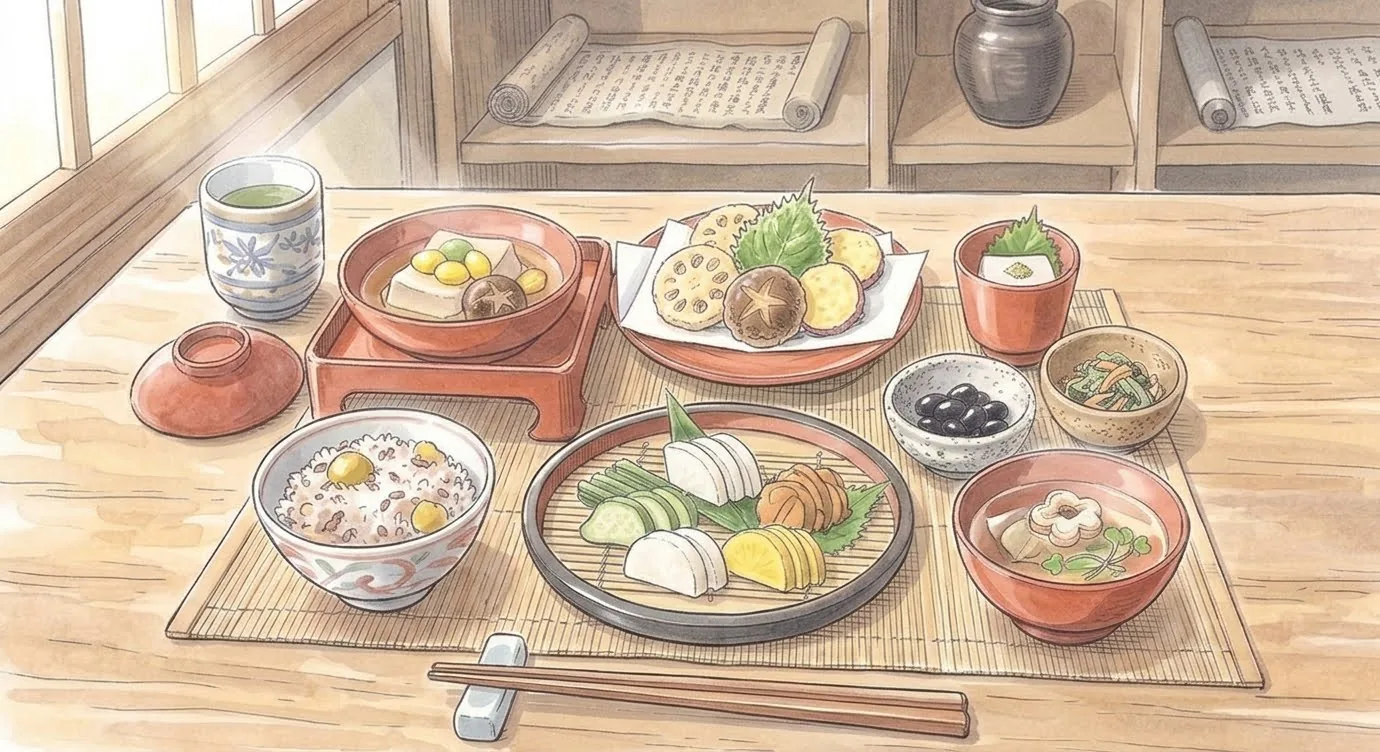
Vegan Asakusa: 4 Vegetarian and Vegan Places Near Senso-ji
Four places within a 12-minute walk of Kaminarimon serve only plant-based food, mostly for about ¥2,000–3,000 a person. The easiest first stop is Marugoto Vegan Dining, 2 minutes from Ginza Line Exit 5. Every dish there is vegan and gluten-free; it's closed Mondays. In ordinary restaurants, watch for dashi, a stock often made from fish.
“It's true that dashi is in a lot of Japanese food.”
Where the shops are
- Marugoto Vegan DiningOpen in Google Maps — Marugoto Vegan Dining
- Shochikuen CafeOpen in Google Maps — Shochikuen Cafe
- InjoyOpen in Google Maps — Injoy
- Nowhere Vegan IzakayaOpen in Google Maps — Nowhere Vegan Izakaya
Numbers match the ranking above. Map: OpenFreeMap © OpenStreetMap contributors.
Where can I eat vegan food near Senso-ji?
Ranked by Tabelog score, with Google Maps ratings alongside (see the chart). The order comes from those ratings, not from our own tasting. Nowhere has no Tabelog page, so it comes last.
| Place | What it is | Walk from Kaminarimon (est.) | Closed |
|---|---|---|---|
| Marugoto Vegan Dining | Vegan curry, tempura, waffles; all gluten-free | 3 min | Monday; Sunday dinner |
| Shochikuen Cafe | Vegan burgers and cakes | 10 min | Open daily |
| Injoy | Buddhist shojin noodles and courses | 4 min | Wednesday per official site (Tabelog: Tuesday) |
| Nowhere Vegan Izakaya | Vegan Japanese pub food, evenings | 12 min | Tuesday, Wednesday |
If you only try one: Marugoto Vegan Dining. It has the highest Tabelog score on the list, it’s 2 minutes from Ginza Line Exit 5, it takes cards, and every dish is vegan and gluten-free, without garlic or onion. It’s closed on Mondays; on a Monday, go to Shochikuen Cafe or Injoy instead.
How we chose and checked:
- Starting lists: Google Maps and Tabelog searches for vegan, vegetarian and shojin ryori (精進料理) places around Kaminarimon. Every fact here comes from the shops, Tabelog, Google or the official sources named.
- Who’s in: places whose own site or Tabelog page says the whole menu is plant-based, within about a 15-minute walk of Kaminarimon. Places with vegan menus that don’t say the whole menu is plant-based are listed separately below, not ranked.
- Open: Google Maps listed all four as operating on October 26, 2026.
- Order: by the score on each shop’s own Tabelog page, read October 26, 2026.
- Facts: hours, prices and payment come from each shop’s site and Tabelog, with dates where the source gives one.
- Taste: we haven’t eaten at these places, so this page compares facts, not flavor.
What is the dashi trap?
A lot of ordinary Japanese food is not vegetarian, even when it looks it. The reason is dashi (出汁), the stock behind a lot of Japanese cooking, as the author, who lives in Tokyo, notes.
The two classic dashi ingredients are kombu (dried kelp) and katsuobushi (dried, smoked bonito flakes). Japan’s farm ministry, MAFF, calls dashi the core of Japanese cooking. The Nipponica encyclopedia (on Kotobank) lists niboshi, dried sardines, as another common base. So a bowl of miso soup, a plate of simmered vegetables or the dipping sauce for soba noodles can contain fish, even when no fish is on the plate.
JNTO, Japan’s national tourism board, warns that even stocks and sauces usually contain some meat. It also notes that the sauce sold with natto (fermented soybeans) is often dashi.
There is a plant-based dashi. Shojin dashi (精進だし) is made from dried shiitake, kanpyo (dried gourd strips) and kombu (Kotobank).
JNTO says traditional shojin ryori is vegan and leaves out garlic and onion. It adds that some modern temples occasionally use dairy.
How do I ask in Japanese?
JNTO suggests carrying a printed card in Japanese that explains what you can’t eat. These short phrases cover the basics:
- I’m vegan. Watashi wa bīgan desu. (私はヴィーガンです)
- I’m vegetarian. Watashi wa bejitarian desu. (私はベジタリアンです)
- I don’t eat meat or fish. Niku to sakana wa tabemasen. (肉と魚は食べません)
- No eggs or dairy, please. Tamago to nyūseihin mo dame desu. (卵と乳製品もだめです)
- Is there fish stock in this? Kore ni dashi wa haitte imasu ka? (これにだしは入っていますか?)
- Is it made with bonito flakes? Katsuobushi wa tsukatte imasu ka? (かつお節は使っていますか?)
Ask about dashi by name, as JNTO advises: say no meat, seafood or animal products, “including dashi or stocks”.
Are Nakamise snacks vegan?
Treat them as sweets, not a meal. The snacks on Nakamise, the shopping street to Senso-ji, are mostly sweets, and we found no ingredient lists for them, so ask.
Ningyo-yaki, the little cakes shaped like lanterns or Kaminarimon, are made from a batter of flour, eggs and sugar (Kotobank), so they aren’t vegan. For fried age-manju buns, we found nothing on what the batter contains or which oil they fry in.
For a quick, cheap meal instead, buy onigiri (rice balls) at a convenience store and choose by the filling (JNTO notes many are filled with fish). Even kelp fillings and flavored rice can hide fish: Lawson’s October 2026 line, including a shiso-kombu and a salted-kombu-and-takuan onigiri, is made with Lawson’s dashi method, which uses bonito flakes (Impress). So check the label every time. For onigiri shops with plant-based fillings on the menu, see our onigiri guide.
The vegan and vegetarian places, ranked
Marugoto Vegan Dining: vegan, gluten-free, by the station
Hanakawado, north of the Ginza Line exits, about 3 min (est.) from Kaminarimon.
Marugoto Vegan Dining (まるごとVeganダイニング浅草) calls itself 100% vegan and gluten-free. Its menu page says there’s no meat, fish, eggs, dairy, honey or animal-based stock. The only exceptions to “gluten-free” are the beer and non-alcoholic beer.
It also leaves out the five pungent vegetables (garlic, onions, green onions, Chinese chives and rakkyo), alcohol in cooking, refined sugar and artificial additives.
The menu includes vegan curry, vegetable tempura, tempeh fries, vegan karaage (fried “chicken”) and gluten-free waffles. There’s a kids’ menu for children up to 7, and dishes can be taken out.
- Hours (November 2026): lunch Tuesday to Sunday 11:30 a.m.–3 p.m. (last order 2:30 p.m.); dinner Tuesday to Saturday 6–8:30 p.m. (last order 8 p.m.); breakfast Wednesday and Saturday 9–11:30 a.m. (official site). The site warns of occasional irregular closures, so check its monthly calendar.
- Closed: Monday, and Sunday evening
- Price: not listed in text on the official menu. Tabelog’s budget from reviews is ¥2,000–2,999.
- Pay: Visa, Mastercard, JCB, Amex, Diners; transit IC cards (Suica etc.); PayPay (Tabelog)
- Reservations: taken, through TableCheck, which shows no prices. Change or cancel only via the confirmation notice, not by phone; if you can’t be reached 10 min after your booked time, it counts as a no-show. Seat-only bookings are limited to 1 hour. No cancellation fee or deadline is stated. 20 seats
- Time needed: allow about 1 hour (the seat-only limit)
- Getting there: 2 min from Asakusa Station, Ginza Line Exit 5, or the Tobu North Exit; 4 min from Toei Exit A5 (Tabelog)
- Address: Yabuki Bldg 1F, 1-3-13 Hanakawado · Google Maps
Shochikuen Cafe: vegan burgers and cakes, open daily
Nishi-Asakusa, on the way to Kappabashi, about 10 min (est.) west of Kaminarimon.
Shochikuen (松竹圓) began as a vegan sweets brand in 2019, and every product it sells is vegan and gluten-free (official shop site). The cafe’s own FAQ says the same about its menu: no animal-derived ingredients and no gluten. Some items contain almonds and walnuts, and no alcohol is used.
The menu has three sections: cakes, burgers and drinks. That makes it the most casual place on this list, and the only one open every day. The menu itself is only posted as pictures, so we can’t give prices; Tabelog’s budget from reviews is ¥1,000–1,999.
- Hours: weekdays 9:30 a.m.–4:30 p.m.; Saturday and Sunday 9:30 a.m.–5 p.m. (official site)
- Closed: no regular closing day
- Pay: JCB and Amex cards, e-money and QR payments (Tabelog; Visa and Mastercard aren’t listed)
- Reservations: not needed; large groups can book ahead, by phone (03-6802-8355). No time limit stated.
- Getting there: about 300 m from Asakusa Station (Tsukuba Express), per Tabelog
- Address: 2-7-6 Nishi-Asakusa · Google Maps
Injoy: Buddhist shojin cooking above the Tobu station
Hanakawado, 3F of the building at the Tobu North Exit, about 4 min (est.) from Kaminarimon.
Injoy (悦納, Etsunō) describes itself as a shojin restaurant, serving Buddhist temple-style cooking; it’s the only one on this list. Its official site calls the food pure vegan: no animal ingredients, no alcohol and none of the five pungent vegetables. It calls the style “oriental vegan”, and serves it with Chinese tea.
Lunch is mostly noodle and rice dishes: shojin tantanmen (sesame-chili noodles), hot-and-sour noodles and stone-bowl bibimbap. Dinner is a set course of nine or ten small dishes, including tofu, yuba (tofu skin) rolls and medicinal-herb soup.
- Hours: open Thursday to Tuesday: lunch 11 a.m.–2 p.m.; dinner 5–7 p.m. (official site). Tabelog lists 11:30 a.m.–2 p.m. and 5:30–8 p.m. instead.
- Closed: Wednesday per its official site (Tabelog lists Tuesday). Phone before you go.
- Price: lunch noodles and bibimbap ¥2,550; pasta and udon sets ¥3,980; dinner courses ¥12,800 and ¥19,800 a person (official menu, read October 26, 2026; tax not stated). Course duration not stated; no cancellation policy stated.
- Pay: cash only, per Tabelog (last edited 2022); confirm payment when you book dinner
- Reservations: none needed for lunch. Dinner is reservation-only: contact the shop by 3 p.m. the day before (03-5830-2333 or renraku@tokyoinjoy.com). 40 seats (Tabelog)
- Getting there: right outside the Tobu North Exit gate; about 1 min from the Ginza Line (official site); 5 min from Toei Exit A5. Take the elevator to the right of the MiniStop to 3F (Google Maps listing).
- Address: 3F, 1-9-1 Hanakawado · Google Maps
Nowhere Vegan Izakaya: evenings across the river
Mukojima, Sumida ward, over Azuma Bridge, about 12 min (est.) from Kaminarimon.
An izakaya is a Japanese pub that serves small plates with drinks, and ordinary izakaya food is full of fish and meat. Nowhere (ノーウェア) does the whole menu vegan and homemade from plant ingredients (official site). Staff speak English and Japanese.
It’s the only evening-only place here, so it suits a dinner after a day around Senso-ji, or a visit to Tokyo Skytree, about 6 min away on foot (official site).
- Hours: 5–10 p.m. (last order 9:30 p.m.), Monday and Thursday to Sunday (official site)
- Closed: Tuesday and Wednesday
- Price: not listed; ask when you call
- Pay: not listed; ask when you call
- Reservations: call 03-6658-4774 (official site). Seats, duration and cancellation policy not listed; ask when you call
- Getting there: walk east over Azuma Bridge from Asakusa, or about 6 min from Tokyo Skytree (official site)
- Address: 1-8-2 Mukojima, Sumida · Google Maps
Vegan sweets
G’DAY Vegan Churros (2-22-8 Asakusa, about 10 min (est.) north of Kaminarimon) says its churros are 100% plant-based, with no eggs, milk or butter. Churros cost ¥900 in caramel, chocolate, matcha or sakura flavors, or ¥1,000 with vegan ice cream, tax included. It’s open Wednesday to Sunday, noon to 6 p.m., and takes cash, cards, transit IC cards and QR payments (official site). The shop notes that traces from shared production lines can’t be ruled out, which matters for allergies more than for veganism.
Shochikuen Cafe (above) is the other choice for vegan cake.
Also has vegan options
These aren’t fully plant-based, or we couldn’t confirm that they are. They’re useful if you’re with friends who eat meat. Always ask about dashi.
- Vegan Eat Tokyo, Asakusa 1-chome, about 5 min (est.) west of Kaminarimon. Tabelog lists “vegan, vegetarian and gluten-free menus”, but doesn’t say the whole menu is plant-based. Dinner pasta sets cost ¥2,700, including tax (Tabelog menu, updated October 30, 2025); cards taken. Hours: check Tabelog; it has irregular days off.
- Fujifuku (小料理バル 藤福), Nishi-Asakusa, about 5 min from Kaminarimon (Tabelog). A small Japanese bar listed on Tabelog as vegan-friendly, with vegan dishes “using no animal products”. Dinner is a set course only, ¥4,000–5,000 (Tabelog menu, updated February 2026); Tuesday to Saturday from 6 p.m.; 9 seats; cards taken. Tabelog doesn’t say the whole menu is vegan.
Places we left out
Vegan Cafe Monkey Magic (Asakusa 2-chome). Reservation-only, with no official website we could find. Tabelog had only three reviews and didn’t confirm the menu is fully vegan.
Which one should I pick?
- Strictest diet (no garlic, onion or gluten): Marugoto Vegan Dining.
- Buddhist shojin cooking: Injoy. Book dinner by 3 p.m. the day before.
- A cheap, quick lunch on the way to Kappabashi: Shochikuen Cafe, open every day.
- With kids: Marugoto, which has a kids’ menu up to age 7.
- Drinks and small plates: Nowhere Vegan Izakaya, from 5 p.m.
- On a rainy day: Marugoto and Injoy are a short walk (about 2 min) from the Ginza Line exits and the Tobu gate (Tabelog; Injoy’s official site).
- On a Monday: Marugoto is closed. Shochikuen, Injoy and Nowhere should be open.
- On a Tuesday or Wednesday: Nowhere is closed both days. Injoy is closed on Wednesday per its official site, but Tabelog lists Tuesday, so phone first. Marugoto and Shochikuen should be open.
- On a Sunday evening: Nowhere, or Injoy (dinner booked by Saturday 3 p.m.); Marugoto serves lunch only on Sundays.
Getting there
Ride the Tokyo Metro Ginza Line to Asakusa. Exit 1 comes up by Kaminarimon; Exit 5 is the closest for Marugoto and Injoy. See Asakusa Station for the Tobu, Toei and Tsukuba Express stations, which are all separate.
Step-free access, by station:
- Asakusa (Ginza Line): no full step-free route. Tokyo Metro lists no elevator inside the gates, only stairlifts; the street elevator at Exit 1 is outside the gates.
- Asakusa (Tobu Skytree Line), for Injoy and Marugoto: Tobu lists an elevator and escalators at the station, but not which exit they serve. We haven’t confirmed a step-free route to the North Exit.
- Asakusa (Toei Asakusa Line): step-free route not confirmed.
- Asakusa (Tsukuba Express), for Shochikuen Cafe and G’DAY: step-free route not confirmed.
Injoy is on the third floor; Google Maps’ listing points to an elevator next to the MiniStop. We haven’t checked step-free access at the other entrances.
Nearby
Marugoto and Injoy are both a few minutes from Senso-ji and Nakamise, so any of them works before or after the temple. Shochikuen Cafe is on the way to Kappabashi, the kitchenware street. For Nowhere, cross the river at the Azuma Bridge viewpoint. For the rest of the day, see Eat & drink and the Asakusa travel guide.