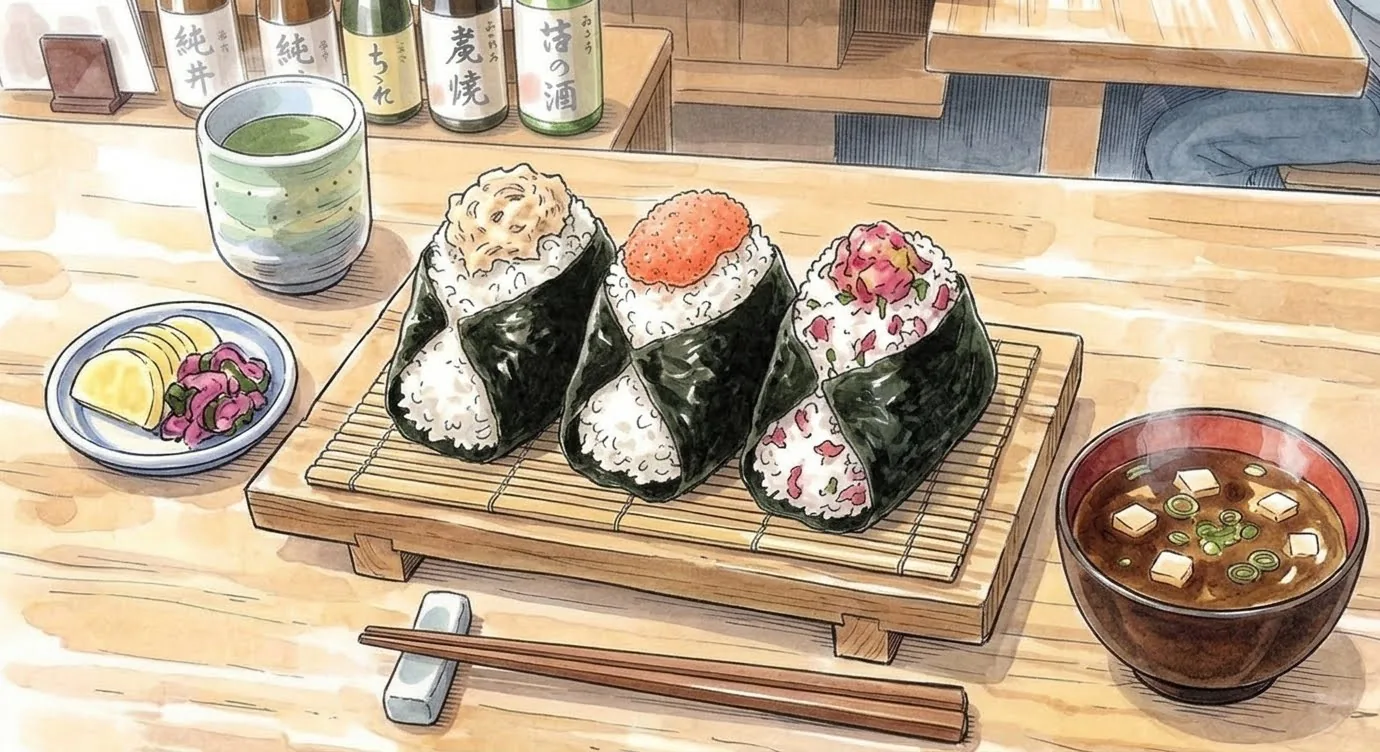
Onigiri in Asakusa: 5 Rice Ball Shops, Prices and Hours
Five onigiri (rice ball) shops within a 12-minute walk of Kaminarimon, ranked by Tabelog score, not our tasting. The one to know is Yadoroku, open since 1954 and a Michelin Bib Gourmand, where two onigiri with miso soup cost from ¥814. Yadoroku is cash only, closed Sundays, and stops when the rice runs out.
“For onigiri, my top pick is Yadoroku. You can eat at the counter, the way you would at a sushi bar, so if you have time, do give it a try.”
Where the shops are
- Onigiri Asakusa YadorokuOpen in Google Maps — Onigiri Asakusa Yadoroku
- Asakusa Onigiri HaruchanOpen in Google Maps — Asakusa Onigiri Haruchan
- Musubi MatsubaOpen in Google Maps — Musubi Matsuba
- Hitonigiri Asakusa ROX 2GOpen in Google Maps — Hitonigiri Asakusa ROX 2G
- MamemusubiOpen in Google Maps — Mamemusubi
Numbers match the ranking above. Map: OpenFreeMap © OpenStreetMap contributors.
Where can I eat onigiri near Senso-ji?
Ranked by Tabelog score, with Google Maps ratings alongside (see the chart). The order comes from those ratings, not from our own tasting.
| Shop | Known for | Walk from Kaminarimon (est.) | Pay | Closed |
|---|---|---|---|---|
| Yadoroku | Open since 1954; Michelin Bib Gourmand | 11 min | Cash only | Sunday (dinner also Tue, Wed) |
| Haruchan | 25+ fillings, English menu, open till 9 p.m. | 10 min | Cards, IC, QR | Irregular |
| Musubi Matsuba | Onigiri with sake and shochu, into the evening | 12 min | Cards, QR | Tuesday, Wednesday |
| Hitonigiri | 38 fillings, set meals, 1 min from the TX exit | 5 min | Cards, QR | Follows Asakusa ROX |
| Mamemusubi | New in 2026, opens 9 a.m. | 9 min | Cards, QR | Monday, Tuesday |
If you only try one: Onigiri Asakusa Yadoroku. It has the highest Tabelog score here, calls itself Tokyo’s oldest onigiri shop (open since 1954), and it’s a Bib Gourmand in the MICHELIN Guide. It’s also the author’s top pick (see his quote). Bring cash, and come early: it’s closed on Sundays and stops when the rice runs out. On a Sunday, go to Haruchan or Hitonigiri instead.
How we chose and checked:
- Starting list: Tabelog’s Asakusa onigiri ranking, read October 26, 2026.
- Who’s in: shops whose main business is onigiri (おにぎり専門店), with seats, within about a 12-minute walk of Kaminarimon. Google Maps listed all five as operating on October 26, 2026.
- Order: by the score on each shop’s own Tabelog page, read October 26, 2026.
- Facts: hours, payment and seats come from each shop’s site, Tabelog and Google Maps; prices from the dated sources named in each section.
- Walk times: our estimate from the map, not a timed walk.
- Taste: we haven’t eaten at these shops, so this page compares facts, not flavor.
Two shops near the top of Tabelog’s list are left out. Misojyu (ミソジュウ, Tabelog 3.48) sells onigiri, but Tabelog files it first as a diner (shokudo), and miso soup is in its name. Akarui Noson (明るい農村, Tabelog 3.27) is a takeout-only counter that also sells sandwiches and bento, and Tabelog lists no seats.
What is onigiri?
Onigiri (おにぎり), also called omusubi (おむすび), is a ball of freshly cooked rice pressed around a filling, often wrapped in nori seaweed. Fillings tend to be salty so that the rice keeps; onigiri is still good once it has cooled (Kotobank dictionary).
At Hitonigiri, each onigiri is shaped after you order (official site). Every shop below sells single onigiri; Yadoroku and Hitonigiri also offer sets with miso soup, and most offer takeout (see each shop).
Why does nori matter in Asakusa?
Asakusa-nori (浅草海苔) is a general Japanese word for dried nori sheets, the kind wrapped around onigiri, and also the name of the seaweed itself (Nihon Kokugo Daijiten). One dictionary says the name comes from seaweed gathered on the shore around Asakusa in the early Edo period (Digital Daijisen). Another gives two other explanations: that nori was farmed or made into sheets on the Sumida River near Asakusa, or that it was sold in the grounds of Senso-ji. The earliest example that dictionary quotes is a cookbook, Ryori monogatari, from 1643 (both on Kotobank).
The author, who lives in Tokyo, adds that nori prices vary a lot with quality. Of the shops below, Yadoroku is the one that names its nori: Edomae (江戸前) nori (official site). Nori quality is one reason onigiri prices differ from shop to shop.
Which filling should I try?
These are the fillings you’ll see most on the menus below, with the Japanese you’ll find on the board:
- Salmon (鮭 or しゃけ, shake): grilled and flaked. Haruchan calls it its most popular filling.
- Pickled plum (梅 or うめ, ume): sour and salty. Haruchan uses honey-pickled Kishu nanko plums; Hitonigiri lists Kishu ume among its recommendations.
- Kelp (昆布, kombu): simmered kelp, sweet and salty.
- Bonito flakes (おかか, okaka): okaka is a word for katsuobushi, dried bonito, usually shaved (Kotobank dictionary).
- Tarako (たらこ) and mentaiko (明太子 or めんたいこ): salted pollock roe; mentaiko is the version cured with chili (Kotobank dictionaries).
- Tuna mayo (ツナマヨ): canned tuna mixed with mayonnaise. Haruchan and Hitonigiri both list it.
- Sujiko (筋子 or すじこ): salmon roe salted while still in its sac (Kotobank dictionary). One of the pricier fillings: ¥690 at Haruchan.
Asked which filling a visitor should try once, the author picks mentaiko or tarako, salted pollock roe. His own favorites are the seafood fillings: sujiko, ikura (salmon roe) and shiokara (salted, fermented seafood, usually squid). Yadoroku’s menu list includes sujiko and ikura.
If you don’t eat meat or fish: some menus list plant-based fillings such as ume, kombu or plain salted rice, and they’re noted in each shop’s section below. A plant-based filling doesn’t make the rice ball fish-free, though: seasonings can contain dashi, a stock often made with bonito, so ask. Our vegetarian and vegan guide to Asakusa has the phrases to use.
The onigiri shops, ranked
Onigiri Asakusa Yadoroku: since 1954, cash only
Kototoi-dori, behind Senso-ji’s main hall, about 11 min (est.) from Kaminarimon.
Yadoroku (おにぎり浅草宿六) has served onigiri “since 1954 when white rice was a luxury item” and calls itself Tokyo’s oldest onigiri restaurant (official English page). It’s a Bib Gourmand in the MICHELIN Guide.
It uses Koshihikari rice chosen each year, Edomae nori and seasonal fillings (official site). The menu list on Tabelog, last updated in 2010, includes kombu, okaka, shirasu (baby sardines), ume, salmon, tarako, sujiko and ikura, along with several pickles.
Ordering: there’s no reservation; you order at the shop, and a takeout order counts too (Tabelog). The shop makes onigiri from one piece, to eat in or take away (official site). With 16 seats and no bookings, and lunch ending when the rice runs out, the safest plan is to arrive close to 11:30 a.m. We found no official word on queues or waiting times.
- Hours: lunch from 11:30 a.m.; dinner from 5 p.m. (official site). Tabelog and Google list lunch until 2 p.m. and dinner until 8 p.m.; the shop’s English page says lunch runs until 3 p.m. Every service ends when the rice runs out.
- Closed: Sunday. No dinner on Tuesday and Wednesday. Closures are posted on the shop’s Facebook and Instagram.
- Price: set A, two onigiri with tofu miso soup and takuan (pickled daikon), from ¥814; set B, three onigiri, from ¥1,100. Fillings over ¥320 cost the difference. Clam, wakame or nameko mushroom in the miso soup: +¥165 (official site, read October 26, 2026).
- Pay: cash only
- Reservations: not taken; time limit not listed
- Seats: 16: 8 at the counter, 8 at two tables. No smoking.
- Kids: children welcome (Tabelog)
- Plant-based fillings: ume and kombu are on the Tabelog list.
- Getting there: 3 min from Asakusa Station (Tsukuba Express), 9 min from the Ginza Line (Tabelog). Toei buses stop at Oku-Asakusa (official site).
- Address: 3-9-10 Asakusa · Google Maps
Asakusa Onigiri Haruchan: open daily, English menu
Asakusa 2-chome, near the Tsukuba Express exit, about 10 min (est.) from Kaminarimon.
Haruchan (浅草おにぎり はるちゃん) opened in April 2024 and posts its full menu with prices: about 25 fillings, from shio-musubi (salted rice, with or without nori) to eel and sujiko. You can put two fillings in one onigiri for ¥100 more, and the menu suggests pairings such as salmon with sujiko or takana (mustard greens) with mentaiko. Its signature side is tonjiru, pork miso soup simmered for seven hours (Tabelog menu, updated December 28, 2025).
Tabelog lists an English menu with photos, English-speaking staff, allergy labeling and free Wi-Fi. It’s the easiest shop on this page if you don’t read Japanese.
- Hours: 10 a.m.–9 p.m. daily, with irregular days off; the shop posts them on Instagram (Tabelog)
- Closed: irregular
- Price: shio-musubi, ume, kombu and okaka ¥390; salmon, tarako, mentaiko and tuna mayo ¥410; sujiko ¥690; eel ¥670; pork miso soup ¥510, all including tax (Tabelog menu, updated December 28, 2025)
- Pay: Visa, Mastercard, JCB, Amex, Diners and UnionPay; transit IC cards (Suica etc.); PayPay, WeChat Pay and other QR payments
- Reservations: not for seats; takeout orders can be booked, and orders of 20 or more need a call by the day before (Tabelog). Time limit and cancellation policy not listed.
- Seats: 15: 7 at the counter, 8 at tables
- Kids: children and strollers welcome (Tabelog)
- Plant-based fillings: shio-musubi, ume, kombu, takana and nori tsukudani (nori simmered in soy). Tabelog marks it as having vegan and vegetarian menus. Its shio-kombu oil onigiri contains bonito flakes.
- Getting there: 1 min from Asakusa Station (Tsukuba Express) Exit A; 10 min from the Ginza Line at Asakusa or Tawaramachi (Tabelog)
- Address: 2-13-4 Asakusa · Google Maps
Musubi Matsuba: onigiri and sake in Nishi-Asakusa
Nishi-Asakusa 3-chome, about 12 min (est.) from Kaminarimon.
Musubi Matsuba (むすび まつ葉) is the one to choose for an evening: Tabelog lists sake and shochu, and it opens in the evening on every day it’s open. It also has a private room. We found no official website or menu, so we can’t give prices; Tabelog’s budget from reviews is ¥1,000–1,999.
Tabelog and Google Maps don’t agree on the evening hours, so phone before a late visit.
- Hours (Tabelog, edited September 2026):
- Monday and Thursday: noon–2 p.m., 5–11 p.m.
- Friday: 11:30 a.m.–2 p.m., 5–11 p.m.
- Saturday: noon–11 p.m.; Sunday: noon–9 p.m.
- Google Maps lists closing at 8:30 p.m., so phone before a late visit.
- Closed: Tuesday and Wednesday
- Price: not listed (no menu on Tabelog or elsewhere we could find); Tabelog’s budget from reviews is ¥1,000–1,999
- Pay: cards, e-money and QR payments (Tabelog; brands not listed)
- Reservations: taken, by phone (070-9090-1946), per Tabelog. Time limit and cancellation policy not listed.
- Seats: not listed; Tabelog notes a private room
- Kids: not listed
- Plant-based fillings: not listed (no menu found)
- Getting there: about 250 m from Asakusa Station (Tsukuba Express), per Tabelog
- Address: 3-20-7 Nishi-Asakusa · Google Maps
Hitonigiri: 38 fillings by the TX exit
Asakusa ROX 2G, on Kokusai-dori, about 5 min (est.) from Kaminarimon.
Hitonigiri (ひとにぎり 浅草ROX2G) opened in October 2025 (Tabelog) on the ground floor of the ROX 2G building. It’s run by Create Restaurants Holdings, whose shop site describes 38 fillings and onigiri shaped one by one after you order, using Uonuma Koshihikari rice from Niigata and Japanese salt and nori.
Besides single onigiri, it serves set meals: tatsuta-age (fried chicken), thick-cut salmon, and unatama (eel and egg), plus an onigiri-and-miso-soup set. The house side is a ginger-spiked pork miso soup, full of vegetables and meat (gudakusan). Prices aren’t given in text on the official site; Tabelog’s budget from reviews is ¥1,000–1,999.
It’s the closest shop to Kaminarimon and open from 10 a.m. every day, which makes it the easy fallback.
- Hours: 10 a.m.–9 p.m. (last order 8:30 p.m.), every day (official site)
- Closed: irregular, following Asakusa ROX
- Price: not listed (the official menu page and Tabelog show no prices in text); Tabelog’s budget from reviews is ¥1,000–1,999
- Pay: cards, e-money and QR payments (Tabelog; brands not listed)
- Reservations: taken, by phone (03-6634-9367), per Tabelog. Takeout available (official site). Time limit and cancellation policy not listed.
- Seats: not listed
- Kids: not listed
- Plant-based fillings: Kishu ume is on its recommended list.
- Getting there: 1 min from Asakusa Station (Tsukuba Express) Exit A1; 5 min from Tawaramachi (Ginza Line); 8 min from the Tobu and Toei Asakusa stations (official site)
- Address: 1F, Asakusa ROX 2G, 1-24-1 Asakusa · Google Maps
Mamemusubi: morning to mid-afternoon, near Tawaramachi
Kotobuki 3-chome, southwest of Kaminarimon, about 9 min (est.) away.
Mamemusubi (まめむすび) opened in January 2026 and is the newest shop here (Tabelog). It opens at 9 a.m., so it’s the one for an early start. Google Maps lists both dine-in and takeout. We found no menu, and the shop’s own website was down for maintenance when we checked; its Instagram is linked from Tabelog. Tabelog’s budget from reviews is under ¥1,000.
- Hours: Wednesday to Friday 9 a.m.–3:30 p.m.; weekends and holidays 9 a.m.–3 p.m. (Tabelog)
- Closed: Monday, Tuesday and the day after a holiday
- Price: not listed (no menu on Tabelog or elsewhere we could find); Tabelog’s budget from reviews is under ¥1,000
- Pay: Visa, Mastercard, JCB and Amex; iD and QUICPay; PayPay and other QR payments (Tabelog)
- Reservations: not listed
- Seats: not listed. No smoking (Tabelog).
- Kids: not listed
- Plant-based fillings: not listed (no menu found)
- Getting there: about 360 m from Tawaramachi Station (Ginza Line), per Tabelog
- Address: 3-17-1 Kotobuki · Google Maps
Which one should I pick?
Plan on about 30 minutes to eat in (our estimate; no shop states a time).
- The classic, and you can come early: Yadoroku, from 11:30 a.m. Bring cash.
- You don’t read Japanese: Haruchan, with an English photo menu and English-speaking staff.
- Nearest to Kaminarimon, or a late lunch: Hitonigiri, about 5 min away, 10 a.m. to 9 p.m.
- Onigiri with a drink in the evening: Musubi Matsuba (phone first), or Yadoroku’s dinner from 5 p.m. on Monday, Thursday, Friday and Saturday.
- Early start: Mamemusubi from 9 a.m., Wednesday to Sunday, or Hitonigiri and Haruchan from 10 a.m.
- Paying by card: every shop except Yadoroku.
- On a rainy day: Hitonigiri and Haruchan have the shortest walk from a station exit, about 1 min each from the Tsukuba Express (official site; Tabelog). The walk itself isn’t covered.
- On a Sunday: Yadoroku is closed. Haruchan, Matsuba, Hitonigiri and Mamemusubi should be open.
- On a Monday or Tuesday: Mamemusubi is closed both days, Matsuba on Tuesday. Yadoroku, Haruchan and Hitonigiri are open (Yadoroku lunch only on Tuesday).
Getting there
Four of the five shops are closest to the Tsukuba Express Asakusa Station, which is separate from the Ginza Line station by Kaminarimon. Hitonigiri gives Exit A1 and Haruchan Exit A; check the exit in each shop’s section. Mamemusubi is closer to Tawaramachi on the Ginza Line. See Asakusa Station for how the five Asakusa stations fit together.
Step-free access, by station:
- Asakusa (Tsukuba Express), for Yadoroku, Haruchan, Matsuba and Hitonigiri: step-free route available. The station map shows an elevator from the platforms to the ticket gates, and a street elevator at Exit A1 on the Kokusai-dori side (Metropolitan Intercity Railway).
- Tawaramachi (Ginza Line), for Mamemusubi: step-free route available (Tokyo Metro). Each platform has its own gate and an elevator-only exit: by the Nishi-Asakusa 1-chome crossing for trains to Shibuya, by Asakusa Post Office for trains to Asakusa.
- Asakusa (Ginza Line): no full step-free route. Tokyo Metro lists no elevator inside the gates, only stairlifts; the street elevator at Exit 1 is outside the gates.
We haven’t checked step-free access at the shops’ entrances.
Nearby
Yadoroku is just behind Senso-ji, so it works before or after the temple: walk through the precinct from Kaminarimon and out the back. Matsuba and Haruchan are a short walk (est.) from Kappabashi, the kitchenware street. For an evening drink after Matsuba or Yadoroku’s dinner, try Hoppy Street. For another lunch, see the best soba in Asakusa or the best tonkatsu, or Eat & drink and the Asakusa travel guide for the rest of the day.