Best Soba in Asakusa: 5 Noodle Shops, Prices and Hours
Five soba shops within a 10-minute walk of Kaminarimon, ranked by Tabelog and Google ratings, not our tasting. Cold soba costs ¥800–1,700 on the latest menus. The easiest first stop is Namiki Yabusoba, 2 minutes away, on Tabelog's Soba Top 100, and it takes cards. Closed days vary from Monday to Friday, so check each shop.
“I recommend zaru soba or mori soba, with tempura on the side. Dip about half the noodles in the tsuyu and slurp them in one go, with noise. That's how Japanese people eat soba. To people from abroad it probably looks like bad manners, and a bit messy. But this is Japan, so why not try it once? When you finish, ask for soba-yu, pour it into your tsuyu and drink it.”
Where the shops are
- HirayamaOpen in Google Maps — Hirayama
- Azumabashi YabusobaOpen in Google Maps — Azumabashi Yabusoba
- Namiki YabusobaOpen in Google Maps — Namiki Yabusoba
- OwariyaOpen in Google Maps — Owariya
- TowadaOpen in Google Maps — Towada
Numbers match the ranking above. Map: OpenFreeMap © OpenStreetMap contributors.
Which soba shops are near Kaminarimon?
Ranked by Tabelog score, with Google Maps ratings alongside (see the chart). The order comes from those ratings, not from our own tasting.
| Shop | Known for | Cold soba | Walk from Kaminarimon (est.) | Closed |
|---|---|---|---|---|
| Hirayama | Seiro soba and tempura, 13 seats | ¥1,200 (Jan 2026 menu) | 10 min | Monday |
| Azumabashi Yabusoba | Lunch-only Yabu-style shop | ¥1,700 (May 2026) | 9 min | Monday, Tuesday |
| Namiki Yabusoba | Old-timer since 1913; duck soba in winter | ¥850 (Mar 2023 menu) | 2 min | Wednesday, Thursday |
| Owariya | Tempura soba, since 1860 | n/a (tempura soba ¥1,600 in 2020) | 4 min | Friday (main shop) |
| Towada | Soba with tempura and tendon sets | ¥800 (Aug 2024 menu) | 2 min | Irregular |
Prices are the latest we could find for plain cold soba (seiro, zaru or mori), with the date of each source. Several are a few years old, so expect prices to have risen.
If you only try one: Namiki Yabusoba. It’s on Tabelog’s Soba Top 100, has the most Google reviews of the five (2,089), takes cards and is 2 min from Kaminarimon. It’s closed on Wednesday and Thursday; on those days, go to Hirayama or Azumabashi Yabusoba instead.
How we chose and checked:
- Starting lists: Tabelog’s Asakusa soba ranking and the Tabelog Soba EAST Hyakumeiten 2025 list (announced July 23, 2025). We found no 2026 soba list on October 25, 2026.
- Who’s in: soba shops within about a 10-minute walk of Kaminarimon that you can walk into at lunchtime. Google Maps listed all five as operating on October 25, 2026.
- Order: by the score on each shop’s own Tabelog page, checked October 25, 2026.
- Facts: hours, closed days, payment and seats come from Tabelog; prices from the dated sources named in each section.
- Walk times: our estimate from the map, not a timed walk.
- Taste: we haven’t eaten at these shops, so this page compares facts, not flavor.
Two well-known shops are left out on purpose, because neither is a casual soba lunch near Kaminarimon. Asakusa Juroku (浅草じゅうろく, Tabelog 3.90) is a dinner-only, mostly course restaurant north of Senso-ji, with a Tabelog budget of ¥10,000–14,999 and, per its Tabelog page, a ¥3,000-per-person service fee for foreign guests. Kyotei Daikokuya (蕎亭 大黒屋) opens only Thursday to Saturday evenings, by reservation, and takes cash only.
What is soba, and how do you order it?
Soba are noodles made from buckwheat flour. Most shops add a binder, usually wheat flour: ni-hachi (二八) soba is eight parts buckwheat to two parts wheat, and soba with no binder at all is called juwari (十割), “100 percent” (Japan’s farm ministry, MAFF; Kotobank dictionary).
You order soba one of two ways: cold with a dipping sauce (tsuyu), or hot in broth.
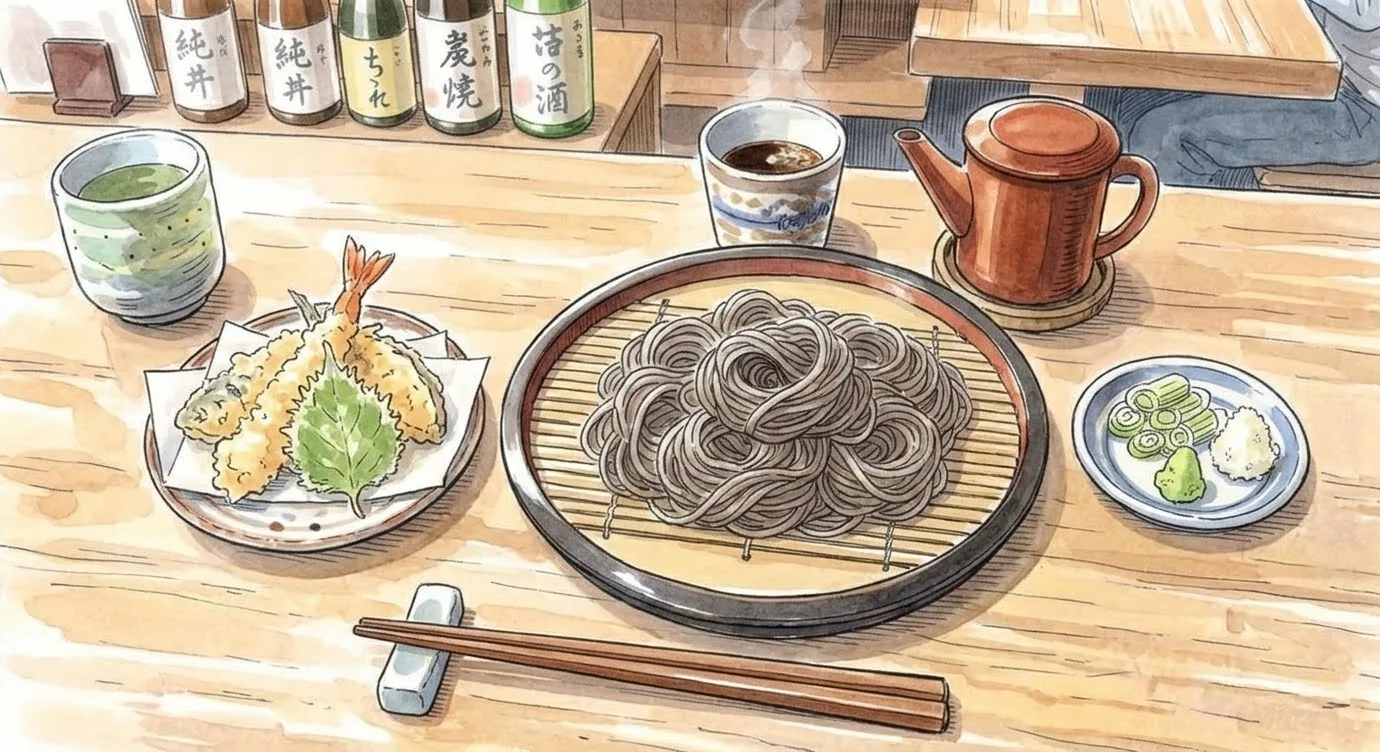
- Mori (もり) or seiro (せいろ). Plain cold noodles on a bamboo tray or in a square box, with a small cup of tsuyu on the side.
- Zaru (ざる). The same, with shredded nori on top. Zaru once had its own, richer tsuyu; today most shops use the same one as for mori (Kotobank dictionary).
- Ten-zaru or ten-mori (天ざる / 天もり). Cold soba with a plate of tempura on the side.
- Tempura soba (天ぷらそば). Hot soba in broth with tempura on top. It’s the dish LIVE JAPAN puts first for Owariya.
- Kake (かけ). Hot soba in plain broth.
- Kamo-nanban (鴨南蛮). Hot soba with duck and leek. Namiki Yabusoba listed it for November to March only.
With cold soba come chopped green onion and wasabi. The usual way is to add them to the tsuyu (MAFF).
How do you eat soba?
- Dip, don’t soak. Pick up a small mouthful of cold noodles with your chopsticks, dip the ends, about half, in the tsuyu and eat it straight away.
- Slurp. Slurping is how soba is eaten here. The owner of Sarashina Horii, a soba shop in Tokyo, says that drawing the noodles in with a slurp lets you enjoy more of their aroma (Kikkoman).
- Finish with soba-yu. After the noodles, many shops bring soba-yu (そば湯), the hot water the noodles were boiled in, in a small pot. Pour some into your leftover tsuyu and drink it (Kotobank dictionary). If it doesn’t come, ask for it.
The quote on this page is practical advice from the site’s Tokyo-based author.
Where to eat soba in Asakusa
Asakusa Hirayama: small, new and best booked
Nishi-Asakusa, toward Kappabashi, about 10 min (est.) from Kaminarimon.
Hirayama (浅草 ひら山) opened in November 2021 and has the highest Tabelog score on this page. It holds a Bib Gourmand, Michelin’s award for good food at a moderate price (MICHELIN Guide Tokyo 2026 listing). It also made the Soba EAST Hyakumeiten list for the first time in 2025 (Tabelog Hyakumeiten).
The menu is short: cold seiro soba, a few hot bowls, tempura by the piece (lotus root, shiitake, conger eel) and small dishes such as rolled omelet and sobagaki, a buckwheat dumpling. It has just 13 seats, and the shop asks guests to book to reduce crowding.
- Hours: Wednesday to Saturday 12–2 p.m. (last food order 1:30 p.m.) and 6–8:30 p.m. (last food order 8 p.m.); Tuesday and Sunday 12:30–2:30 p.m. only
- Closed: Monday. Tuesday and Sunday lunches are mainly for course bookings (Tabelog).
- Price: seiro soba ¥1,200, extra seiro ¥900, hot kake ¥1,300, tempura from ¥900 a piece, all including tax (Tabelog menu, updated January 2026). Dinner prices are before tax. Tabelog’s budget is ¥2,000–2,999 and ¥8,000–9,999 (lunch and dinner aren’t labeled); the higher figure probably reflects dinner courses.
- Pay: Visa and Mastercard; no e-money or QR payments
- Reservations: through the shop’s official booking site (URL not confirmed) or by phone (03-5830-6857), per Tabelog. The whole party must arrive together. A same-day cancellation, change of party size or late arrival may be treated as a cancellation or charged a fee; Tabelog gives no amount. Maximum party size: not listed (13 seats).
- Getting there: 2 min from Tawaramachi Station (Ginza Line) via the elevator exit, according to Tabelog
- Address: 1-3-14 Nishi-Asakusa · Google Maps
Azumabashi Yabusoba: lunch only, across the river
Azumabashi, Sumida ward, just over Komagata Bridge, about 9 min (est.) from Kaminarimon.
Azumabashi Yabusoba (吾妻橋 やぶそば) is on the far side of the Sumida River, a short walk from the east end of Komagata Bridge. Its owner, Jiro Umeoka, trained for 17 years at Kanda Yabusoba and opened his own shop in 1984 (Serai, May 2026). Tabelog notes it later moved to its current address.
It’s on Tabelog’s Soba EAST Hyakumeiten list for 2025 and 2024, and was picked in 2017, 2018, 2019, 2021 and 2022. It serves lunch only, five days a week, and closes when the soba runs out. With 18 seats, come early.
- Hours: 11:30 a.m.–3 p.m. (last order 2:30 p.m.), Wednesday to Sunday; closes early if the soba sells out
- Closed: Monday and Tuesday
- Price: mori soba ¥1,700; ten-nuki (a shrimp kakiage fritter in warm broth, without noodles) ¥1,400; sake from ¥800 a cup (Serai, May 2026 issue)
- Pay: cash only
- Reservations: not taken. 18 seats
- Getting there: about 5 min from Asakusa Station (Toei Asakusa Line): take the exit toward Komagata Bridge and cross it, according to Tabelog
- Address: 1-11-2 Azumabashi, Sumida · Google Maps
Namiki Yabusoba: since 1913, by Kaminarimon
About 2 min (est.) south of Kaminarimon.
Namiki Yabusoba (並木藪蕎麦) has been in Asakusa since 1913 (Tabelog), in a building of its own just south of Kaminarimon. It’s on Tabelog’s Soba EAST Hyakumeiten list for 2025 and 2024, and was picked in 2017, 2018, 2019 and 2021.
The menu is classic: zaru and kake soba, ten-zaru, tempura soba and, in winter, kamo-nanban duck soba. Besides tables it has five raised tatami platforms (koagari) for four, where you take your shoes off.
- Hours: 11 a.m.–7:30 p.m. (last order 7 p.m.)
- Closed: Wednesday and Thursday
- Price: zaru soba ¥850, ten-zaru ¥2,000, tempura soba ¥2,000, kamo-nanban ¥2,100 (November to March), on the March 2023 menu posted by a Tabelog user. Prices have probably risen since. Tabelog’s budget is ¥1,000–1,999.
- Pay: Visa, Mastercard, JCB, Amex and transit IC cards (Suica etc.); no QR payments
- Reservations: not taken. 36 seats, all non-smoking
- Getting there: 1 min from Exit A4 or A5 of Asakusa Station (Toei Asakusa Line; Tabelog also lists the Ginza Line)
- Address: 2-11-9 Kaminarimon · Google Maps
Owariya: tempura soba since 1860
Two shops, on either side of Kaminarimon; the main shop is about 4 min (est.) west.
Owariya (尾張屋) was founded in 1860, and LIVE JAPAN’s guide leads with its tempura soba. It has two shops: the main shop (honten) west of Kaminarimon and a branch (shiten) to the east, right by the Ginza Line exit (LIVE JAPAN). They close on different days, so one of them is usually open. Both are big, with 70 seats each (Tabelog).
- Hours (main shop): 11:30 a.m.–8 p.m.; Thursday 11:30 a.m.–4 p.m.
- Closed (main shop): Friday, and January 1
- Hours (branch, 1-1-3 Asakusa): 11:30 a.m.–8 p.m.; Tuesday 11:30 a.m.–4 p.m. Closed Wednesday, one irregular day a month, and three-day breaks in February, June and September (Tabelog).
- Price: tempura soba ¥1,600 and tendon ¥1,700, including tax, in a 2020 LIVE JAPAN guide; we found nothing newer, so expect more now. Tabelog’s budget for the main shop is ¥3,000–3,999 listed, ¥1,000–1,999 from reviews.
- Pay: cash only, at both shops
- Reservations: evening course bookings only (6–8 p.m., 2-hour limit), up to 3 days ahead; 100% cancellation fee on the day, 50% the day before (Tabelog). Course price: not listed. No seat-only bookings
- Kids: children welcome; strollers can’t come inside but can be left outside (Tabelog, main shop)
- Getting there: about 4 min from Asakusa Station (Tsukuba Express), according to Tabelog
- Address: 1-7-1 Asakusa (main shop) · Google Maps
Towada: cards, long hours, tempura sets
Metro-dori, about 2 min (est.) northeast of Kaminarimon.
Towada (十和田) has the longest, most flexible hours on this page. Tabelog files it under soba first, then tendon and udon. It opens from late morning to 8 p.m. or later, apart from irregular days off, and has 62 seats over two floors. It takes cards and QR payments, including Alipay and WeChat Pay.
The menu leans on sets of soba with tempura or a tendon rice bowl, and all prices include tax.
- Hours: weekdays 11:20 a.m.–8 p.m. (last order 7:30 p.m.); weekends and holidays 11 a.m.–8:30 p.m. (last order 8 p.m.). Tabelog advises phoning ahead, as hours can change.
- Closed: irregular days; check the shop’s Tabelog page
- Price: mori soba ¥800; two-shrimp ten-mori ¥1,500; mori soba with a mini shrimp tendon ¥1,500 (¥1,300 elsewhere on the same page); weekday shrimp tendon with mini seiro ¥2,000, on the Tabelog menu updated August 2024. Prices may have risen since.
- Pay: credit cards (including UnionPay), e-money and QR payments
- Reservations: Tabelog’s listing is inconsistent, but its notes say guests are seated in order of arrival, so assume walk-in
- Getting there: 2 min from Asakusa Station (Ginza Line), 4 min from the Toei Asakusa Line, according to Tabelog
- Address: 1-33-5 Asakusa · Google Maps
Which one should I pick?
- Highest-rated, and you can plan ahead: Hirayama. Book online, and arrive with your whole group.
- A Yabu-style lunch and a river walk: Azumabashi Yabusoba, Wednesday to Sunday before 2:30 p.m. Bring cash.
- Nearest to Kaminarimon with a long history: Namiki Yabusoba, about 2 min away. Takes cards.
- Tempura soba: Owariya. Bring cash.
- Cards, long hours, no plan: Towada.
- Winter duck soba: Namiki Yabusoba lists kamo-nanban from November to March.
- On a rainy day: Namiki Yabusoba, Owariya and Towada are 2–4 min (est.) from Kaminarimon, and Hirayama is 2 min from Tawaramachi Station (Tabelog) but about 10 min from Kaminarimon, so a longer wet walk from there. Azumabashi Yabusoba means crossing the river on an open bridge.
- On a Monday: Hirayama and Azumabashi Yabusoba are closed. Namiki Yabusoba, Owariya and Towada should be open (Towada has irregular days off).
- On a Wednesday or Thursday: Namiki Yabusoba is closed both days, and the Owariya branch on Wednesday. Hirayama, Azumabashi Yabusoba, Towada and the Owariya main shop are open (Owariya until 4 p.m. on Thursday).
Getting there
Ride the Tokyo Metro Ginza Line to Asakusa and take Exit 1, which comes up by Kaminarimon. See Asakusa Station for the Tobu, Toei and Tsukuba Express stations.
Step-free access, by station:
- Asakusa (Ginza Line): no full step-free route. Tokyo Metro lists no elevator inside the gates, only stairlifts; the street elevator at Exit 1 is outside the gates.
- Tawaramachi (Ginza Line), for Hirayama: step-free route available (Tokyo Metro). Each platform has its own gate, and an elevator-only exit runs from that gate to the street: by the Nishi-Asakusa 1-chome crossing for Platform 1 (to Shibuya), by Asakusa Post Office for Platform 2 (to Asakusa).
- Asakusa (Toei Asakusa Line), for Namiki Yabusoba and Azumabashi Yabusoba: step-free route not confirmed.
- Asakusa (Tsukuba Express), for Owariya: step-free route not confirmed.
We haven’t checked step-free access at the shops’ entrances.
Nearby
Namiki Yabusoba, Owariya and Towada are all a few minutes from Senso-ji, so any of them works before or after the temple. Hirayama is on the way to Kappabashi, the kitchenware street. From Azumabashi Yabusoba, you can walk back to Asakusa over Azuma Bridge, one bridge north of Komagata Bridge, and stop at the Azuma Bridge viewpoint. For another lunch idea, see the best tonkatsu in Asakusa, or Eat & drink and the Asakusa travel guide for the rest of the day.